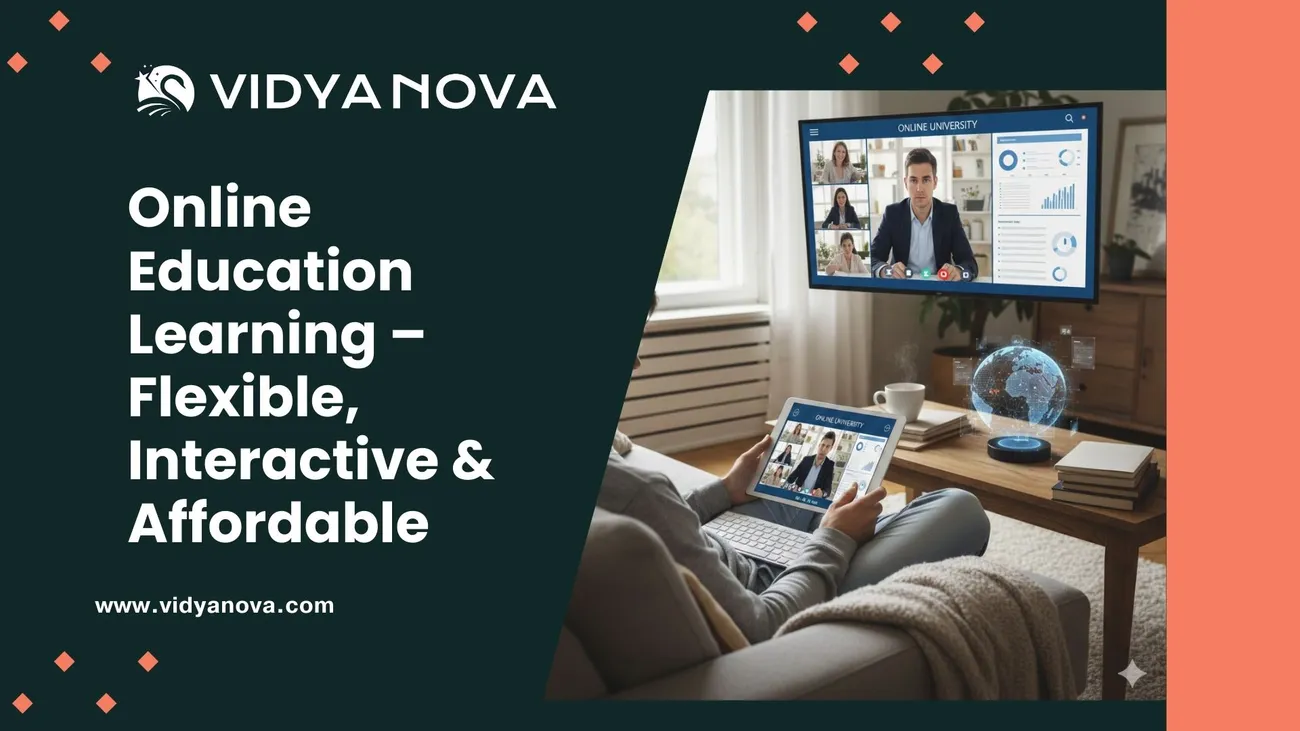
Online Education Learning – Flexible, Interactive & Affordable
Short summary of the blog : Online education has evolved into a flexible, interactive, and affordable way to learn for students, professionals, parents, and educators. With self-paced modules, live virtual classrooms, hands-on projects, and credible certifications, online learning helps people gain real skills faster and fit education into busy lives. Choosing the right platform, focusing on projects, and getting regular feedback are key to turning online courses into meaningful career and academic opportunities.
I started teaching online in a small, noisy room with a shaky webcam. Back then I thought nothing could replace face to face. Now I know better. Online learning has developed from a mere convenience to an actual, effective method of learning that is suitable to anyone, a student in school, a student in college, a person preparing competitive exams, a working professional upgrading their skills or even a parent looking for the best educational option for their child.
If you're here, you probably want real answers: Is online learning flexible enough for my schedule? Will I actually engage with the course? Can I get an affordable certification that employers respect? I cover all of that here, with tips I use with students and professionals every week. No fluff. Just what works.
Why online learning matters right now
Lets start with the obvious. The world just keeps changing at a rapid pace. Different kinds of jobs, different exams, and new tools seem to come out every single month. So, how can traditional classrooms always be in sync? Online learning platforms provide you the freedom of being more adaptable, in fact, way faster than traditional means. It takes you just a few weeks rather than years to learn a new skill. And you can study wherever you want: your home, a coffee shop, or even during your commute. It is simply more flexible.
In my experience, three advantages stand out: flexibility, interactivity, and affordability. Those are not marketing words. They're practical benefits people notice when they commit to an online course.
- Flexible learning online. Study when it fits your life, not the other way around.
- Interactive experience. Live classes, virtual classrooms, peer groups, and hands-on projects keep learning real.
- Affordable online courses. Many platforms cut costs by removing overhead. That lowers the price you pay while still offering quality education.
Flexible learning online: what it really looks like
Flexibility isn't only about "on-demand videos." It's about choices. You should be able to choose your pace, your path, and where you learn. Here are ways flexibility shows up in good online education.
- Self, paced modules that allow you to replay difficult lessons over and over again.
- Live sessions scheduled at different times or recorded so people from other time zones can get up to speed.
- Microlearning, brief, concentrated lessons that you can complete between work tasks.
- Mobile access so learning continues on your phone during commutes.
I've taught college students who fit advanced modules around a part time job. I've helped working professionals take certification courses that required a few hours a week for three months. The key is to find a platform that actually supports those options. Not every site labeled "self paced" delivers decent structure. That's a common pitfall.
Interactive learning: keep students engaged
Passive video watching rarely results in real skill change. Interactivity makes the difference. Virtual classrooms and active tasks help students retain what they learn and apply it faster.
Think of interactivity in three layers.
- Teacher to student. Regular live classes, Q and A sessions, and clear feedback from instructors make students feel supported.
- Peer interaction. Group projects, discussion forums, and study groups replicate the energy of a campus classroom.
- Hands, on practice. Getting around a skill through assignments, quizzes, and real world projects is the way it works, rather than just understanding the skill.
I've noticed learners who do weekly peer reviews learn twice as much as those who watch videos alone. It's not mysterious. Explaining a concept to someone else forces clearer thinking. If a platform only offers recorded videos and no peer interaction, expect a slower learning curve.
Affordable online courses: how to get value
Affordability is more than price. It's return on investment. A cheap course that leaves you confused is not affordable in the long run. On the other hand, a slightly pricier course with real mentorship and certification can pay for itself.
Here are practical ways to evaluate cost and value.
- Compare course content, not just price. Does the syllabus match current industry needs?
- Check for included mentorship, grading, or career services. Those services matter.
- Look for project based learning and a portfolio. Employers value proof you can actually do the work.
- Search for scholarships, bundles, and payment plans. Many platforms offer flexible payments for working learners.
One mistake I see all the time: students buy the cheapest course and then wonder why they lack practical experience. Spend a little time vetting instructors and projects. That small effort pays off.
Virtual classrooms and real connection
Virtual classrooms are definitely more than just video calls. If properly implemented, they have the potential to replicate the very best of a traditional classroom: a teacher explaining a concept in real, time, students immediately asking questions, and picking up students' expressions through the teacher's voice. A quality platform integrates live events with chat, polls, breakout rooms, and recorded playback.
When you pick a virtual classroom, test these features.
- Does the teacher use live demos and screen sharing?
- Are sessions recorded and easily searchable?
- Can you join breakout rooms for small group work?
- Is there active moderation in discussion channels to keep things on track?
I've seen courses where instructors simply read slides. Those are the ones that lose engagement. Prefer teachers who use real examples, code on the fly, or walk through case studies. That's the sign they're comfortable teaching, not just presenting.
Distance learning that actually works
Distance learning is usually considered one thing only. However, it is actually a mixture of different methods. It entails planning the curriculum, figuring out how to get the students motivated, and implementing the technology that will make the communication as smooth as possible. If any one of these three parts does not work properly, the whole experience will be affected.
Here are things that help distance learning succeed.
- Clear weekly objectives. Students should know what success looks like each week.
- Frequent low stakes assessments. Short quizzes and micro assignments prevent last minute cramming.
- Accessible support. Mentors and teaching assistants who reply within 24 to 48 hours make a big difference.
- Feedback loops. Quick, actionable feedback helps learners improve in real time.
For competitive exam aspirants, this structure is gold. Breaking the syllabus into daily mini goals turns a mountain into manageable steps.
Online certification courses and credibility
Certificates matter only to the extent that someone cares about them. Typically, recruiters focus on three main aspects: skills, projects, and learning paths. Getting a certificate certainly adds value, but the real money is in demonstration of work.
If you want certificates that employers respect, do this.
- Choose courses aligned with industry standards and tools people actually use.
- Build projects you can show off. A link to a working demo will always be more convincing than a certificate.
- Think of certifications as an indicator that a person is worthy of hiring, not the only proof. Pair them with a portfolio and brief stories on how you executed the work.
A quick tip from my mentoring sessions. When listing a course on your resume, add a two line project description. For example, "Built a responsive web app to track student study hours using React and Node. API integrated with Google Sheets for reporting." That small detail makes the certificate relevant.
Choosing the appropriate online learning platform
There are hundreds of online platforms for learning. Choosing the one that fits your goals is more important than just going for the most popular one. Here is a checklist I often share with students.
- Goal alignment. Does the platform offer courses that match your target skill or exam syllabus?
- Instructor quality. Look for instructors with real experience, not just academic titles.
- Learning format. Do you prefer live classes, self paced modules, or hybrid?
- Assessment and projects. Are there graded assignments and hands on work?
- Community. Can you interact with peers and mentors?
- Career support. Does the platform offer placement assistance, mock interviews, or resume feedback?
Don't ignore the course sample. Watch the first lesson. Join a live session. That quick check often tells you more than a thousand reviews.
Common mistakes and how to avoid them
I've seen the same issues show up over and over. Here are common mistakes and quick fixes you can use today.
- Buying too many courses at once. Pick one clear goal and finish it before starting another. Completion beats accumulation.
- Skipping projects. Projects are where learning sticks. Schedule time for them the same way you schedule classes.
- Learning without application. Try teaching a concept to a friend or writing a short blog about it. Application deepens retention.
- Ignoring community. Join study groups or forums. People help each other more than you expect.
- Underestimating time. Estimate and then add 30 percent. Learning takes more time when you apply it.
One small habit I've recommended is the "two line summary." After each lesson, write two sentences about what you learned and one sentence about how you'll use it. This takes two minutes and keeps knowledge active.
Practical tips to make online learning stick
These are straightforward practices that separate successful online learners from passive watchers.
- Set a study window. Block the same time each day and treat it like a real class.
- Create a learning space. It does not have to be fancy. A quiet corner with decent internet is enough.
- Use active notes. Write small summaries and questions. Highlight concepts you need to apply.
- Do a weekly review. Spend 20 minutes reviewing notes and projects every Sunday.
- Pair up. Find a study buddy to keep each other accountable.
One exception: flexibility. If you travel for work, shift your study window. The point is consistency, not rigid timing.
Examples that keep it simple
Here are three short examples that show how people from different backgrounds use online learning.
- School student. Riya uses a hybrid model. She watches core subject videos at 6 a.m., joins a live doubt clearing session at 7 p.m., and does a short quiz at night. Her scores improved because she reviews every day.
- Working professional. Ahmed needed a data analytics certificate for a promotion. He took a part time course with weekend labs and built a dashboard project he used in his interview. He got the promotion in three months.
- Career switcher. Priya transitioned from finance to UX design. She followed a project based course, built a portfolio of three apps, and reached out to industry mentors for feedback. Within six months she landed freelance work.
Each of these examples shows a simple pattern: set goals, do projects, and get feedback. That is the core of effective distance learning.
Parents and educators: how to support online learners
Parents often worry about screen time, quality, and motivation. Educators want to keep standards high while using new formats. Here are practical tips for both.
- Set clear expectations. Agree on study hours and outcomes. This removes confusion.
- Create structure. Use calendars and short check ins to track progress.
- Encourage application. Ask learners to show a project or problem they solved each week.
- Monitor quality. Verify that courses use current tools and include assessments.
A common mistake is treating an online course like passive TV. Make it interactive. Ask kids to teach you what they learned in five minutes. Oddly enough, that helps them more than another hour of watching videos.
Boost Skills Fast with Interactive Online Coaching Classes
Educators and trainers: tips for designing great online courses
If you teach, you know the challenge of keeping learners engaged remotely. Here are design practices that work.
- Begin the lesson by setting clear learning outcomes.
- Each lesson should give a response to the question: what will students be capable of doing? Vary formats tell a story using different media.
- Incorporate brief videos, live demonstrations, quizzes, and teamwork activities. Give the students the opportunity to work on scaffolded projects. Divide large projects into weekly milestones.
- Offer frequent feedback. Even short comments guide learners better than long reports every month.
- Use real world examples. Students connect more when they see practical relevance, such as exploring do identical twins have the same fingerprints to understand genetics and human development.
I sometimes run a "micro project sprint." Learners complete a small task in 48 hours. It forces iteration and gives immediate feedback. It works better than long assignments that never get finished.
How to measure success in online education
Numbers matter, but context matters more. Completion rates, exam scores, and job placements are useful. Still, you should also measure skill application and confidence.
Simple metrics to track.
- Completion rate of core modules.
- Project submission and quality.
- Post course placement or role change.
- Student confidence scores before and after the course.
For competitive exam prep, performance on timed mock tests is a direct indicator. For professional skills, an employer or client project within six months shows real impact.
Common pitfalls of online platforms and how to spot them
Not all platforms are created equal. Here are warning signs to watch for.
- Poor instructor interaction. If instructors rarely respond to questions, the course will feel lonely.
- Outdated content. Tools and frameworks change fast. Course content should be updated regularly.
- No projects. If you cannot build something by the end of the course, you will struggle to prove your skills.
- Hidden costs. Watch for paid certificates or assessment fees after you enroll.
Don't be shy about emailing support or asking a course question before you buy. Their response often reveals how the platform treats learners.

Why Vidyanova fits into this picture
I've worked with many platforms. Vidyanova stands out because it focuses on flexible learning online, real interactivity, and affordable online courses. The platform is built for learners who want practical outcomes, not just slick marketing.
Vidyanova offers live virtual classrooms, self paced courses, and project based learning. That combo helps students finish courses and build portfolios. They also provide mentorship and timely feedback. In my experience, that feedback is the most underrated feature of an online course.
If you want to explore Vidyanova, check course samples and try a live session. Look at the projects and instructor credentials. You will quickly see whether the platform matches your needs.
Quick checklist before you enroll
Use this short checklist the next time you consider an online course.
- Watch the first lesson and a live demo.
- Confirm projects and assessment methods.
- Check instructor availability and response time.
- Look for alumni outcomes or placement numbers.
- Check refund and payment policies.
Taking these steps reduces buyer regret. You will pick a course that fits your pace and gives you something concrete to show at the end.
Next steps: getting started without overwhelm
Starting can feel overwhelming. Here's a simple path you can follow this week.
- Decide the skill or exam you want to focus on.
- Find two course options and compare their syllabus and projects.
- Watch the sample lessons and attend a trial live session if available.
- Pick one course, set weekly goals, and commit to a study window.
- Start the first project within the first two weeks.
Small steps beat big plans. You do not need to finish everything in three months. You just need to start and keep moving forward.
"Learning online is not about shortcuts. It is about using the right structure and support to move faster and apply what you learn." — A quick note from my tutoring sessions
Helpful links and next steps
Want to explore courses, read more, or talk to someone about what will work for you? Here are a few helpful links.
Final thoughts
Online learning is flexible, interactive, and often affordable. It is not magic. It takes structure, practice, and feedback. But when you pick the right platform and use simple habits, you learn faster and build things you can show to others.
If I had to give one piece of advice, it would be this. Focus on projects and feedback. Certificates help. Real work helps more. Build something. Share it. Improve it. That is how online education turns into real opportunity.
Ready to take the next step? If you want a short chat about which course fits your goals, I recommend booking a quick meeting with Vidyanova. It's the fastest way to get personalized direction and avoid common mistakes.