What Is Adaptive Artificial Intelligence and How It Works
Adaptive artificial intelligence is a term that has been largely characterized as the next big thing in the EdTech industry, notably in boardroom discussions and product roadmaps. Nevertheless, the question of its real significance and the reason why founders, product managers, and educators should be interested still lingers remains. In fact, the adaptation AI systems are those that change their behavior progressively with time as they get new data and interactions. They are not simply systems that obey a predetermined set of rules. They learn from users and adjust in real time.
I've seen teams confuse adaptive AI with simply adding a recommendation widget. That is insufficient. Adaptive AI incorporates models, feedback loops, and design decisions, thus the system evolves into a more helpful tool, the greater the number of users employing it. Such a post would explain the concept of adaptive AI, its functioning, showcase some real, world examples, and enumerate some feasible steps to create and assess it. I’ll keep things hands on, with a focus on applications in education and training.
Why adaptive AI matters now
We live in a fast moving world where learning needs and business priorities shift quickly. Traditional AI models are trained once, then shipped. They often degrade as user behavior and content change. Adaptive AI solves that by continuously updating itself. That matters for EdTech because learners are diverse, curricula evolve, and engagement patterns vary by cohort and season.
In my experience, adaptive artificial intelligence gives products two big advantages. First, it personalizes at scale. Second, it keeps improving without a full retrain every release cycle. That saves time for teams and yields better outcomes for learners.
What is adaptive AI, clearly put
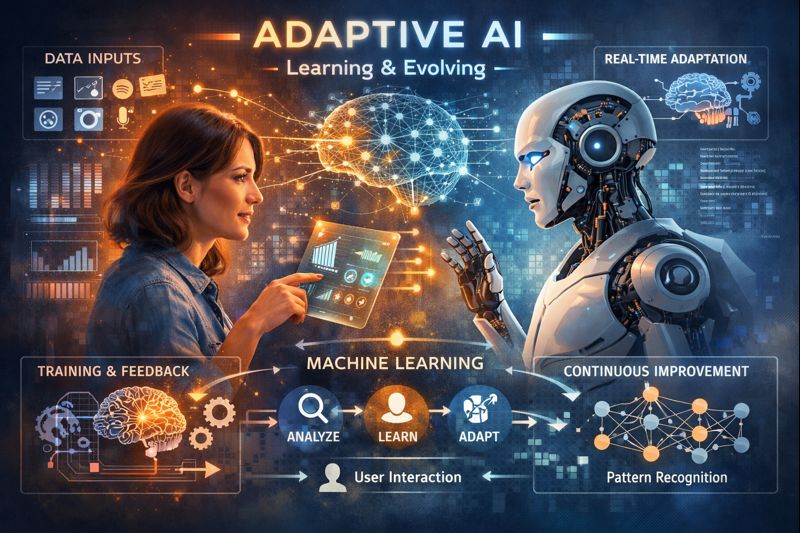
Think of adaptive AI systems as three things working together: an insight engine, a feedback loop, and a decision layer. The insight engine models users and content. The feedback loop collects signals from user interactions. The decision layer chooses actions like recommending a lesson, adjusting difficulty, or triggering an intervention.
In plain terms, adaptive AI monitors what users do, learns what works, and changes its behavior. It might change recommendations, tweak assessments, or alter content sequencing. Over time it gets better at matching instruction to individual needs.
Core components of adaptive AI systems
- Data collection - Clicks, quiz results, time on task, explanations, self reports, and contextual info. The more relevant signals you collect, the better the system can adapt.
- User modeling - Representations of learner state. These can be simple vectors, mastery profiles, or probabilistic models like Bayesian knowledge tracing.
- Adaptation logic - Rules or learned policies that map state to actions. This is where adaptive intelligence algorithms live.
- Evaluation and monitoring - Metrics and A/B tests to verify improvements and detect regressions.
- Safety and guardrails - Constraints to prevent harmful or biased behavior.
Put differently, adaptive AI models plus a feedback loop equals continuous improvement. The secret sauce comes from selecting the right signals and adapting in a way that aligns with your learning objectives.
How adaptive AI works - step by step
Let’s break the process into five simple steps. This is how I explain it to product teams when we sketch an MVP.
- Observe. Collect interaction data. Example signals: quiz correctness, time spent on a video, number of hints used, responses to open questions.
- Infer. Estimate learner attributes. Is the user fluent in topic A? Do they guess often? Use models like logistic regression, Bayesian Knowledge Tracing, or neural nets.
- Decide. Choose an action. Present a harder problem, remedial content, or a motivational message. Decisions can be rule-based or optimized by reinforcement learning.
- Act. Deliver the chosen content or intervention. Track how the learner responds.
- Update. Feed the new signal back to the model. The next decision will use a refined estimate of the learner's state.
That loop repeats often. In simple systems the update is lightweight, like recalculating a mastery score after a quiz. In more advanced systems the update can involve online learning or continual retraining of models.
Adaptive AI vs traditional AI
How is adaptive AI different from the standard machine learning approach? Traditional AI is largely static. A model is trained on historical data, validated, and then deployed. When performance goes down, you retrain the model with new data. This is a fine process for stable tasks.
Adaptive AI, on the other hand, is centered around continuous learning and being responsive. It does not stop updating with new data. This is why it is more appropriate for fast, changing environments such as personalized learning, where the system has to respond to the user's progress and the changing content.
Here are a few concrete contrasts:
- Update cadence, Traditional AI typically relies on periodic retraining. Adaptive AI, on the other hand, updates continuously or at very frequent intervals.
- Responsiveness, Adaptive AI is able to respond to the individual user behavior almost instantly.
- Goal orientation, Adaptive systems, in general, are capable of optimizing for long, term learning outcomes rather than just short, term metrics.
- Complexity, Adaptive AI entails more infrastructure requirements such as streaming data, model monitoring, and safety checks
- Do not think that adaptive AI is always the best option. There are many cases of narrow tasks where a static model is simpler and more reliable. However, if personalization, changing content, or user behavior are factors, then adaptive AI has obvious advantages.
Adaptive AI models and algorithms
There is no single way to build adaptive AI. Different problems need different tools. Below are common model families and when to use them.
- Bayesian models - Good for modeling uncertainty in learner knowledge. Bayesian Knowledge Tracing is classic for mastery estimation.
- Factorization and matrix completion - Useful for recommendation tasks like suggesting next content or practice items.
- Supervised learning - Logistic regression or gradient boosted trees for predicting outcomes like dropout risk or mastery after a lesson, enhanced by Freight & Freight & Logistics services for scalable data operations.
- Reinforcement learning - When you want to optimize sequences of interventions and consider future outcomes. Use with care because it needs a lot of data and safety constraints.
- Online learning - Algorithms that update model weights incrementally as new data arrives. They reduce retrain latency.
- Hybrid approaches - Combine rule-based paths with learned models for robustness. For example, a rule ensures minimum coverage of core topics while models personalize difficulty.
My rule of thumb is start simple. Use interpretable models first. You can later add complexity like reinforcement learning once you understand user behavior and have enough data.
Simple example: adaptive quiz
Here is a small, human friendly example to make this real. Imagine you have a quiz that should adapt to learner ability.
- Start with a baseline difficulty level.
- If a learner answers three questions correctly in a row, raise difficulty by one step.
- If they miss two in a row, lower difficulty by one step.
- Track correctness and response time to refine the learner model over time.
This rule-based adaptive loop works well early on. It is easy to explain to teachers and easy to monitor. Later, you can swap the rules for a probabilistic model that estimates mastery more smoothly.
Adaptive artificial intelligence examples
Seeing is believing. Here are a few practical adaptive AI examples from education and beyond.
- Personalized learning pathways - Systems recommend the next lesson based on performance and learning goals. The plan changes as measurements come in.
- Intelligent tutoring systems - Tutors adapt prompts and hints based on a student’s current misconceptions.
- Adaptive testing - The test adjusts question difficulty in real time to estimate ability faster and with fewer items.
- Content recommendation - Suggest videos, exercises, or readings that match skill gaps and engagement signals.
- Workplace training - Adaptive AI personalizes onboarding and compliance reminders for employees.
- Customer support bots - Bots adjust their responses based on user frustration signals and past resolutions.
These adaptive artificial intelligence applications show that the same principles apply across contexts. The specifics change, but the loop of observe, infer, decide, act, update stays the same.
Adaptive AI in education - why it's a match
Education benefits from adaptive AI for a few reasons. Learners differ widely in background, motivation, and pace. Adaptive AI helps meet learners where they are. It also supports teachers by spotting who needs help and what kind of help they need.
In my experience working with educators, the biggest win is reducing wasted practice. When a learner sees content that is too easy or too hard, engagement drops. Adaptive systems keep difficulty aligned with ability, which boosts motivation and learning gains.
Benefits of adaptive artificial intelligence
Here are the main benefits you can point to when pitching adaptive AI features to stakeholders.
- Personalization at scale - Tailor learning paths for thousands of users without manual effort.
- Improved outcomes - Better alignment with learner needs usually increases retention and mastery.
- Faster insights - Continuous updates reduce time from signal to action.
- Efficient content use - Surface the right materials and avoid redundant practice.
- Better engagement - Content that fits ability keeps learners involved.
Those benefits are compelling, but they don't come for free. You need the right data, engineering, and design trade offs.
Common mistakes and pitfalls
I've watched teams rush into adaptive AI and run into the same errors. A few avoidable pitfalls to watch for.
- Poor signal selection - Not all data is useful. Tracking lots of noisy metrics can mislead models. Focus on signals tied to learning goals.
- Opaqueness - Teachers and learners need to understand why the system made a recommendation. Lack of transparency hurts trust.
- Overfitting to short term behavior - Optimizing only for engagement can lead to clickbait content rather than deep learning.
- No guardrails - Adaptive systems can propagate bias or push learners into suboptimal paths if constraints are missing.
- Cold start - New users and new content have limited data. Have fallback logic to handle sparse data.
- Ignoring UX - Even great models fail if the interface is confusing. Match model outputs to clear user actions.
One quick example of a pitfall: using time on page as the only signal for engagement. Learners might leave the tab open and skew the model. It happens more than you think.
Practical implementation tips
Ready to build? Here are practical tips I share with product teams wanting to add adaptive AI features.
- Start with a clear learning objective - Define what success looks like. Is it mastery of a skill, course completion, or retention?
- Choose meaningful signals - Focus on quality signals like correctness, error types, and hint usage. Use proxies sparingly.
- Ship a simple loop first - Build a rule-based or lightweight model as an MVP. Use it to collect data and learn user patterns.
- Instrument everything - Log events consistently. Missing or inconsistent logs make adaptive AI brittle.
- Use interpretable models early - Teachers need to trust the system. Simple models are easier to explain.
- Design for cold start - Provide demographic or diagnostic questions to seed the learner model.
- Monitor for fairness and bias - Regularly check recommendations across groups and add constraints where needed.
- Plan for rollbacks - Adaptive systems change behavior. Include safety switches and rapid rollback processes.
Small, iterative experiments matter here. Try a targeted A/B test before committing to a system wide rollout.
How to evaluate adaptive AI
Evaluation is both technical and educational. You need to show the system improves real learning outcomes, not just clicks.
Key metrics include:
- Learning gains - Pre and post assessments to measure mastery improvements.
- Retention - Does adaptive instruction increase course completion?
- Engagement quality - Session length plus signal quality like active responses versus passive viewing.
- Efficiency - Time to mastery. Adaptive systems shall lessen the overall time required to achieve goals.
- Fairness and equity, Implementation of the system should be equally fair and equitable for all cohorts, demographic groups, and proficiency levels.
Just a handful of primary metrics should be employed, and the remainder should be reserved for diagnostics. According to my experience, an excessive number of KPIs weakens the concentration and prolongs the execution of rounds.
Data and privacy considerations
Adaptive AI depends on user data. That raises important privacy and security questions. You need to balance personalization with respect for user privacy.
Practical steps include:
- Collect only what you need. Think minimal viable signals.
- Use anonymization and aggregation techniques wherever possible.
- Give users and educators the controls as well as clear explanations on how data is used.
- Respect rules such as FERPA in the US or GDPR in Europe.
- Ensure that data is encrypted both when it is being transmitted and when it is stored, and manage access tightly.
Never consider privacy as an afterthought. The early design decisions about which data to collect and how to keep it will ensure that you won't have to deal with problems later.
Human in the loop - why teachers matter
Adaptive AI should enhance human teaching, not replace it. Teachers bring context, emotional intelligence, and judgment. In many successful deployments, teachers act as the final evaluators and use AI as a diagnostic assistant.
Design the product so teachers can override recommendations, see why a student got a suggestion, and provide feedback that feeds the model. That feedback loop makes the adaptive system more accurate and more accepted.
Deployment and scaling tips
Scaling adaptive AI means handling more data, more users, and more content. From an engineering perspective, pay attention to these areas.
- Streaming pipelines - Use robust event pipelines to collect and process signals in near real time.
- Model versioning - Track model versions, training data, and evaluation metrics.
- Feature stores - Centralize features for offline training and online inference.
- Monitoring - Track both technical health and learning outcomes. Set alerts for performance regressions.
- Cost management - Adaptive systems can be compute intensive. Optimize inference costs and consider hybrid online/offline updates.
Operational maturity matters here. If you skip proper monitoring and versioning, your model updates will become risky and hard to trace.
Ethical considerations and fairness
Adaptive AI can unintentionally amplify bias. If a model sees less data for certain groups, it may provide poorer recommendations. That creates a cycle where underrepresented learners receive worse outcomes.
Mitigation strategies include regular fairness audits, stratified evaluation by subgroup, and hard constraints that ensure minimum service levels. Transparency helps too. When teachers and learners understand the system's logic, they can catch errors and challenge bad behavior.
When not to use adaptive AI
Adaptive AI is not a silver bullet. Avoid it in these cases:
- When data is scarce and you cannot validate behavior.
- When the task is legally sensitive and must be fully auditable with human oversight.
- When the costs of getting adaptation wrong are high, such as in high stakes testing without proper safeguards.
Sometimes a well designed static solution with clear human review is better. Use adaptive AI where the benefits outweigh the risks and you can monitor performance closely.
Read more : AI in E-Learning Portals: The Future of Personalized Learning Paths
Future trends in adaptive intelligence
We will see a few trends in the next few years.
- Hybrid models - Combining symbolic rules with learned models to get both reliability and flexibility.
- Better few shot learning - Allowing models to adapt quickly with limited data.
- Context aware adaptation - Systems that consider environment and emotional signals when adapting.
- Privacy preserving adaptation -Techniques such as federated learning to adapt models without gathering sensitive data in a central place.
These trends will put adaptive AI within reach smaller teams and in environments that are sensitive, e.g., K, 12 schools.
Quick implementation checklist
Before you start building, run through this checklist. It helps align product, engineering, and learning teams.
- Define clear learning outcomes and success metrics.
- Identify a small set of high quality signals to collect.
- Design simple initial adaptation logic and fallbacks for cold start.
- Set up data pipelines, model versioning, and monitoring as if it were your first day.
- Put teachers and experts of the domain in the loop for interpretation and feedback.
- Guarantee that privacy, fairness, and safety measures are implemented.
- Run controlled experiments before wide release.
It sounds like a lot, but you can get a useful adaptive prototype running in a few sprints if you keep scope tight.
Real world case study sketch
Here is a short fictional sketch that illustrates how an EdTech startup might use adaptive AI.
Imagine a startup building a math practice app for middle school. They start with a simple adaptive quiz loop: track correctness and time. After initial testing, they add a hint usage signal. They notice students who use hints early tend to guess. The team adds a small Bayesian model to estimate guessing probability and adjusts item selection accordingly.
After several months, they roll out an intervention that routes students who show repeated misconceptions to short micro-lessons. Teachers get a dashboard summarizing who needs help and why. The startup sees faster time to mastery and higher teacher satisfaction. They kept the system transparent and added guardrails to prevent the model from locking students into narrow paths.
This example reflects a pragmatic approach. Start small, learn, and expand. Keep teachers in the loop and measure real learning outcomes.
Final thoughts
Adaptive artificial intelligence can be extremely potent; however, it requires meticulous design and ethical constraints. If implemented properly, adaptive AI systems can enhance learning, extend personalization, and enable teachers to direct their time to the most valuable areas. On the other hand, if they are executed inadequately, such systems can lose trust and result in inferior outcomes.
If you are building EdTech products, think about adaptation as a feature set, not just a model. Start with simple, interpretable systems. Instrument heavily. And iterate with teachers and learners in the loop.
At vidyanova we try to keep these principles front and center when designing AI features. We believe adaptive AI should empower educators and learners, not replace human judgment.
Helpful Links & Next Steps
Want to chat about how adaptive AI can fit into your product roadmap? Book a meeting and we can walk through practical next steps together.
FAQs
1. What is adaptive artificial intelligence?
Adaptive artificial intelligence is a type of AI that learns from data and user behavior over time and automatically adjusts its responses to improve accuracy and personalization.
2. How does adaptive AI work?
Adaptive AI works by continuously analyzing data, learning from interactions, and updating its models in real time to make better decisions without manual reprogramming.
3. Where is adaptive artificial intelligence used?
Adaptive artificial intelligence is widely used in education, healthcare, business analytics, recommendation systems, and personalized learning platforms.