The Benefits of AI in Improving Student Engagement and Curiosity
The application of AI in education has been transformed from a far, fetched idea to a common educational tool in classrooms. Educators implement AI classroom instruments to individualize instruction, edtech creators are developing smarter platforms, parents are learning about AI, powered learning for their children, and students are discovering new ways to be curious. As per my experience, if we use AI in a right manner, not as a flashy show but as a tool that helps pedagogy, then student’s engagement and curiosity increase very quickly.
This write, up is a thorough guide on how AI can help student engagement and curiosity. I will reveal the methods that work, the ones that do not, and the ways through which educators and creators can use AI learning platforms without losing what matters most: genuine human interaction and purposeful learning. You will find here the real, life scenarios, common mistakes, and the steps which you can use tomorrow in your class or on your learning platform.
Why engagement and curiosity matter (and why technology often gets it wrong)
Engagement means more than just getting people's attention. It involves a person's emotional connection, his/her conscious effort, and the attitude of coming back and trying again. Indeed, curiosity is the motor that drives deeper learning, it makes students want to ask questions, try different options, and relate the ideas. So if both are there, learning stays rather than goes.
However, most edtech tools are merely concentrating on their flashy features instead of these results. They gamify the surface, level behaviors (clicks, time on task) without encouraging real inquiry. I have found that tools that focus on novelty rather than pedagogy will lose their effectiveness very soon. Sure, students might be excited at the beginning, but their curiosity decreases when the challenges don’t escalate or the feedback is not given in the proper context.
That is the point where intelligent, goal, oriented AI comes into play. AI, as a matter of fact, should not be a teacher replacement but rather a means of extending their capabilities, providing adaptive scaffolds, giving feedback timely, and offering personalized pathways that not only attract curiosity but also keep the engagement level high.t.
How AI boosts engagement: concrete ways it works
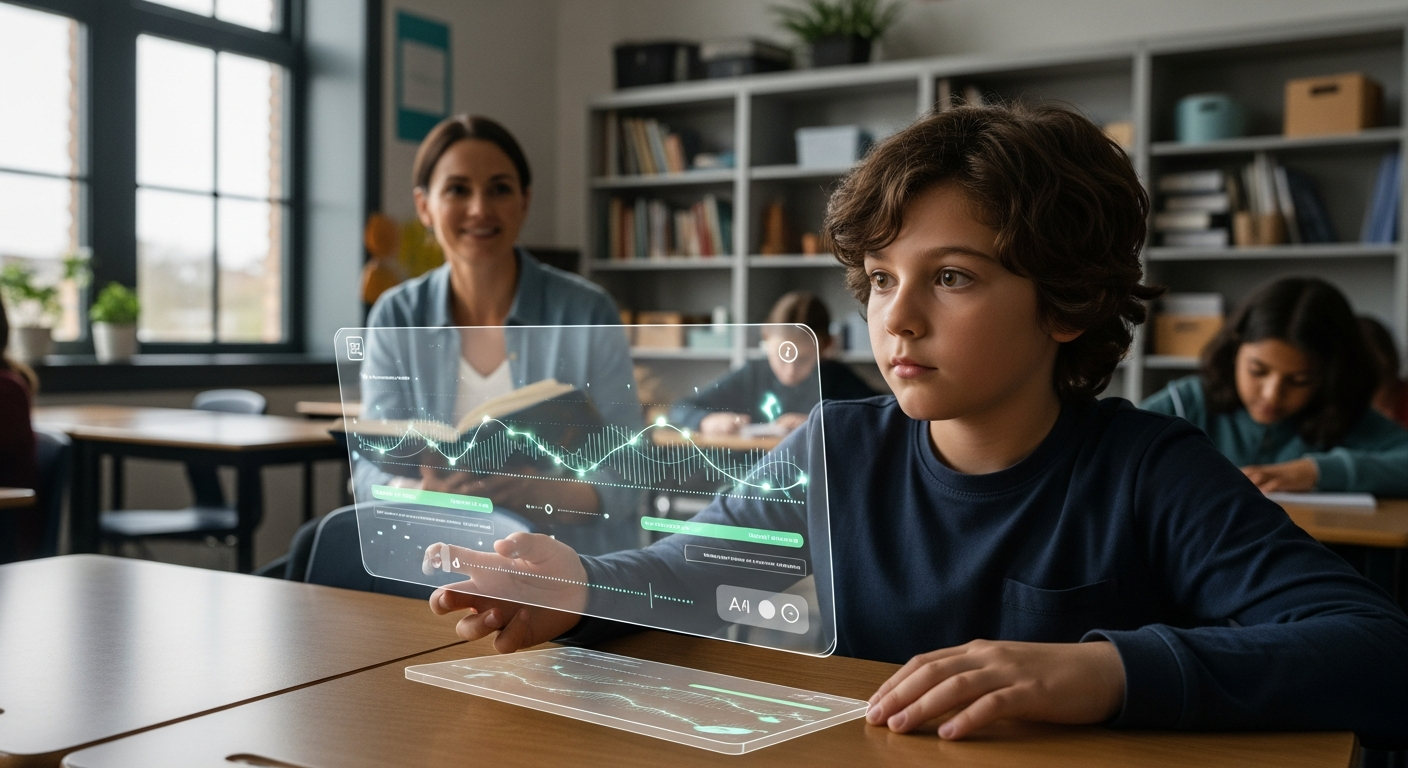
AI-powered learning and adaptive learning technology solve specific problems that have kept teachers and designers up at night. Here are the main mechanisms by which AI improves engagement.
- Personalized learning paths. Adaptive learning AI analyzes student performance and adjusts difficulty, pacing, and sequencing. Instead of everyone following the same path, learners encounter challenges that are just right for them. That “sweet spot” keeps students motivated, not bored, not overwhelmed.
- Immediate, actionable feedback. Students need to know where they went wrong while the idea is still fresh. AI grading and feedback systems can provide instant hints, model solutions, or micro-explanations. These bite-sized clarifications keep momentum and reduce frustration.
- Microlearning and reinforcement. Microlearning AI delivers short, focused bursts of content timed to optimize retention. When paired with spaced repetition algorithms, lessons become stickier and less intimidating.
- Dynamic content generation. AI tools can generate tailored questions, real-world problems, or variations on tasks so students don’t plateau on the same prompts. That variety feeds curiosity, students start to wonder what comes next.
- Engaging multi-modal experiences. AI makes it easy to blend text, audio, visuals, and simulations. For example, language learners can practice speaking with an AI tutor that corrects pronunciation, while a science student experiments in a simulated lab.
- Predictive insights for early intervention. AI learning platforms can flag disengagement patterns early (like inconsistent completion or declining performance). Teachers get alerts and suggested interventions, enabling timely outreach before students fall behind.
AI fuels curiosity: not by guessing, but by provoking
Curiosity thrives on two things: interesting questions and manageable uncertainty. Good AI doesn’t hand answers away. Instead, it nudges students into productive cognitive tension, that sweet spot where they want to learn more.
For instance, a science AI tutor might present a surprising simulation outcome and ask students to hypothesize why it happened. The tool can then adjust follow-up prompts depending on student reasoning. In other words, AI can create branching inquiry paths that lead learners deeper, rather than pushing shallow content at scale.
In my experience, students become more curious when they're given control and clear consequences. Personalized AI tools that let learners choose topics, set goals, and see progress help build ownership. That feeling, I'm exploring this for myself, is a powerful motivator.
Examples and use cases, from K-12 classrooms to online courses
AI resources differ to a great extent, in the sense that they have various effects on different educational milieus. Underneath are the practical scenarios where AI leads in the engagement and makes the learners’ drive for knowledge arouse in different contexts.
- K-12 blended classrooms: Teachers administer adaptive platforms to individualize homework assignments. Students who are having difficulties receive scaffolded problems while advanced students are given enrichment projects which are AI, generated. Grading tasks which take up a lot of the teachers’ time are done less by teachers and instead they are more involved with targeted small, group instruction.
- Higher education and MOOCs: Artificial Intelligence (AI) teaching assistants can manage the queries that students usually have in large online courses, thereby instructors becoming available to run discussions and create better assignments. To enable learners to take in the most necessary material, adaptive quizzes are used.
- Corporate and professional learning: Microlearning AI serves brief modules that can easily be accommodated into the daily schedules of the people who are always busy. With personalized learning paths starting with the areas where the learners have skill gaps, the completion rates as well as retention are increased.
- Online course creators and edtech founders: AI, enabled learning platforms have the capacity to produce numerous variations of lesson plans, quiz banks, and micro, cases. It simply means that creators can test different methods and change according to the real user data.
- Parents and homeschoolers: AI classroom tools can provide the necessary extra support for home education through their ability to offer personalized practice and feedback, at the same time, giving parents the freedom to decide the pace and content.
What good AI tools actually do (the checklist I use when evaluating platforms)
When I'm vetting AI tools for my classroom or recommending one to a colleague, I look for specific capabilities. Vendors often advertise features, but these are the ones that actually move the needle on engagement and curiosity.
- Adaptive assessments that change in real time.
- Clear, scaffolded feedback (not just a score).
- Content variety, problems, simulations, and projects.
- Transparent data and teacher dashboards for insight.
- Controls for privacy, data ownership, and bias monitoring.
- APIs or export options so you’re not locked in.
- Support for microlearning modules and spaced repetition.
These are the ai tools for teachers that actually support classroom workflows. If the vendor can’t show teacher usage data, student outcomes, or explain how their adaptive model works (in plain language), proceed with caution.
Design patterns that increase engagement (actionable tactics)
Designing lessons for AI-powered learning isn’t magic. It’s about clear goals and a few practical strategies that work across subjects. Here are techniques I’ve used and seen others adopt successfully.
- Chunk content into micro-lessons. Students retain better with 5–12 minute focused activities. Use AI to s
- equence these chunks adaptively and to prompt review at optimal intervals.
- Mix challenge types. Include procedural practice, conceptual questions, and creative tasks. AI can generate each type and adjust proportions based on performance.
- Use hypothesis-driven prompts. Ask students to make and test predictions in simulations. Then let AI analyze their hypotheses and offer tailored next steps.
- Provide scaffolds that fade. Start with worked examples, then gradually remove hints as competence improves. Adaptive models can adjust fading speed per learner.
- Surface curiosity hooks. Begin modules with a surprising fact, question, or short video. AI can A/B test hooks to see what prompts continued engagement.
- Encourage reflection. Use short, AI-scored prompts that ask students to explain reasoning. Reflection deepens learning far more than repeated multiple-choice practice.

Common mistakes and pitfalls (and how to avoid them)
There’s no one-size-fits-all solution. But I see the same avoidable mistakes over and over. Below are the pitfalls to watch for and practical fixes.
- Relying on AI to create curriculum end-to-end. Some teams expect AI to replace instructional design. That’s a fast route to generic content. Fix: Use AI to augment teachers’ design work, not replace it.
- Confusing engagement metrics with learning. High click-through or time-on-task doesn’t equal understanding. Fix: Track mastery-based outcomes and use pre/post assessments.
- Neglecting teacher workflows. Tools that add extra work will be abandoned. Fix: Choose platforms that integrate into existing LMSs and reduce grading load.
- Overpersonalizing without guardrails. Hyper-personalization can silo learners or miss equity needs. Fix: Maintain shared goals, group work, and exposure to diverse perspectives.
- Ignoring data ethics and privacy. Student data is sensitive. Fix: Demand clear data policies, minimal data collection, and local control of records.
Measuring success: what to track besides “engagement”
Tracking engagement is necessary but not sufficient. In my experience, the most meaningful indicators blend behavioral data with learning outcomes.
- Mastery gains: Pre/post tests for core skills.
- Transfer tasks: Performance on novel problems that require applying learned concepts.
- Persistence: Repeated attempts and voluntary return to tasks over time.
- Quality of explanations: AI-scored or teacher-reviewed written responses that show depth of reasoning.
- Student agency: Choice activity completion rates and reflection logs.
- Social learning: Peer review and collaboration metrics indicating shared knowledge construction.
Combine these measures with surveys and classroom observation to get a full picture. That triangulation helps you avoid false positives, like thinking students learned because they “liked” an activity.
Implementation roadmap for schools and course creators
Getting AI into a classroom or platform doesn't have to feel overwhelming. Here’s a roadmap that balances speed with careful design.
- Start small. Pilot a single unit or grade level with a clear learning objective. Keep the scope narrow.
- Choose tools that integrate. Look for platforms that work with your LMS and data policies. Prioritize teacher-facing dashboards.
- Train teachers alongside the pilot. Teacher buy-in makes or breaks adoption. Offer hands-on workshops and co-design sessions.
- Collect qualitative and quantitative data. Use surveys, interviews, and analytics to evaluate impact weekly during the pilot.
- Iterate and scale. Improve prompts, scaffolds, and pacing based on evidence. Then expand to more classes.
- Plan for sustainability. Build local capacity and documentation so the program doesn’t rely on one champion.
Teacher-student relationship: still the core
Let me be clear: AI is a tool, not a teacher. No algorithm replaces the human judgment, empathy, and motivation that teachers provide. I've seen tech implementations fail precisely because they ignored relationship-building. Students need adults who notice when they’re stuck, encourage risk-taking, and model curiosity.
That said, AI can give teachers time back. When repetitive tasks like grading or routine question answering are automated, teachers can design richer in-person experiences: discussions, projects, and mentorship. We should use AI to amplify those human moments rather than erode them.
Equity and inclusion: making AI work for all learners
Artificial intelligence is capable of closing the gaps through offering tailored support to learners who would possibly be left out. Nevertheless, it is capable of duplicating bias if the training data is not diverse. According to my experience, the fairest implementations are those which follow three principles:
- Contextualize models: Make AI more personal by adjusting it to local curricula and languages rather than just using big, generic models.
- Monitor and audit: Continually check for bias in the results (for instance, cultural assumptions in word problems or uneven scaffolding across groups).
- Maintain teacher oversight: Teachers should have a possibility to reject AI suggestions and create fair interventions.
Costs and ROI: what to expect
Costs vary widely. Some AI classroom tools are subscription-based with per-student pricing. Others charge per course or have enterprise licensing. When evaluating ROI, don’t just compare price tags. Consider the value of teacher time saved, improved retention rates, and higher completion for paid courses.
For example, an online course creator who uses adaptive assessments and microlearning AI can increase completion rates and thus revenue per student. In K-12 contexts, districts may see improved standardized test performance or reduced remediation needs. Calculate both direct savings (less grading time) and indirect gains (better outcomes, higher satisfaction).
Real-world lessons from early adopters
From talking to teachers and startup founders, a few themes repeat:
- Successful pilots protect teacher time and give teachers control over AI settings.
- Students respond well to AI when its role is transparent, they understand why a tool recommended a path.
- Iterative improvement beats big-bang rollouts. Update prompts, collect feedback, and refine models continuously.
- Cross-functional teams (instructional designers + engineers + teachers) create the best experiences.
As a small aside, one teacher shared how AI-generated problem banks helped her flip the classroom: she used AI to create variants of algebra problems and spent class time on strategy, not routine practice. The result? More lively debates and students teaching each other different solution methods.
Top AI-powered learning features that actually keep students curious
If you’re building or choosing a platform, prioritize these features. They’re the ones that have repeatedly sparked curiosity and kept learners coming back.
- Adaptive pathways: Personalized sequences based on performance and goals.
- Scenario-based simulations: Real-world problems where choices matter.
- AI tutors and chat assistants: On-demand hints and Socratic questioning.
- Content remixing: Automatic generation of alternative problem sets and projects.
- Progress storytelling: Visual dashboards that show growth and next learning opportunities.
Practical tips for teachers and creators getting started
Here are quick, actionable tips you can apply this week. These are based on what I’ve seen work across classrooms and online platforms.
- Start with one topic and replace a single worksheet with an adaptive micro-lesson.
- Pair AI feedback with a human reflection task, a short journal or discussion prompt.
- Use AI to generate three variations of a problem and assign them as differentiated groups.
- Set measurable goals: completion, mastery, and one qualitative measure like “student finds topic interesting.”
- Collect weekly teacher and student feedback to iterate quickly.
Future directions: where ai in education is headed
We’re at the beginning of a long arc. Expect better natural language tutoring, more realistic simulations, and improved cross-modal feedback (text, audio, video). Microlearning AI will get smarter about spacing and retrieval, increasing long-term retention. Meanwhile, AI teaching assistants will become more conversational and context-aware, helping scale mentorship.
But technology will only advance learning significantly if we keep pedagogy first. The best innovation blends empirical instructional design with powerful ai powered learning features. When those two meet, engagement and curiosity aren’t just improved, they become central to how we teach and learn.
Read More:
Top 10 Online Courses After 12th You’ve Probably Never Considered But Should
The Benefits of AI in Improving Student Engagement and Curiosity
Checklist before you adopt a tool
Quick checklist to use when evaluating ai learning platforms and ai classroom tools:
- Does it align to your learning goals and standards?
- Is teacher control and transparency built in?
- Are data privacy and ownership clear?
- Can it export data and integrate with your LMS?
- Does it offer microlearning and adaptive pathways?
- Are there support materials and professional development?
Final thoughts: use AI to amplify curiosity, not automate it away
AI in education offers real promise for improving student engagement and curiosity. When designed and used thoughtfully, AI teaching assistants and adaptive learning technology enhance learning by meeting students where they are, offering timely feedback, and creating space for deeper inquiry.
From my classroom experiments and conversations with founders, the same truth keeps resurfacing: AI’s power lies in amplification. It amplifies good instruction, good questions, and good coaching. But it won’t replace them. So if you’re an educator, start small, prioritize pedagogy, and involve students in the process. If you’re a creator or edtech leader, invest in teacher tools, transparent models, and iterative testing. And if you’re a parent or student, look for platforms that explain what the AI does and why.
Curiosity is contagious. Use AI to catch it, nurture it, and send it back into the classroom.