How Artificial Intelligence is Revolutionizing Learning Commerce: AI Tools for Online Course Success
Short Summary :
Artificial intelligence is transforming learning commerce by connecting course creation, personalization, and sales into one intelligent system. From faster content production and adaptive learning paths to AI-powered marketing, pricing, and learner support, AI helps course creators and EdTech teams improve engagement, conversions, and retention. This guide breaks down practical AI use cases, tools, and implementation steps that help online courses scale sustainably without losing the human touch that makes learning effective.
Artificial intelligence is revolutionizing our methods of producing, marketing, and scaling online courses. If you are a course creator, operate an e, learning platform, or are responsible for marketing digital learning products, you have likely experienced this transformation already. The tools are becoming more intelligent.The audience expects more. And the business side of learning is starting to look a lot more like commerce than education alone.
In this post I'll walk through practical ways AI improves learning commerce. I'll share real tactics you can try, common mistakes to avoid, and simple examples that make the ideas usable. I’ve seen these approaches work with course creators and EdTech teams. You can use them whether you are just getting started or you are scaling a platform.
Why AI matters for learning commerce
We used to treat course creation and course sales as two separate tasks. Create the content. Put it on a platform. Promote it. AI changes that picture because it connects content, experience, and commerce in real time.
Think of AI in three short ways. It helps create content faster. It personalizes experiences at scale. It optimizes commercial outcomes automatically. Bring those three together and course creators get higher engagement, better conversions, and clearer insights into what actually helps learners buy and succeed.
That is the reason why expressions such as artificial intelligence in commerce and AI learning commerce are emerging in product roadmaps and investor decks. They are more than mere buzzwords. They depict a collection of methods that enhance the production, marketing, and selling of digital learning.
Core AI capabilities transforming online courses
Let’s break AI down into the capabilities that make the biggest difference for learning commerce. I’ll keep the examples simple and practical.
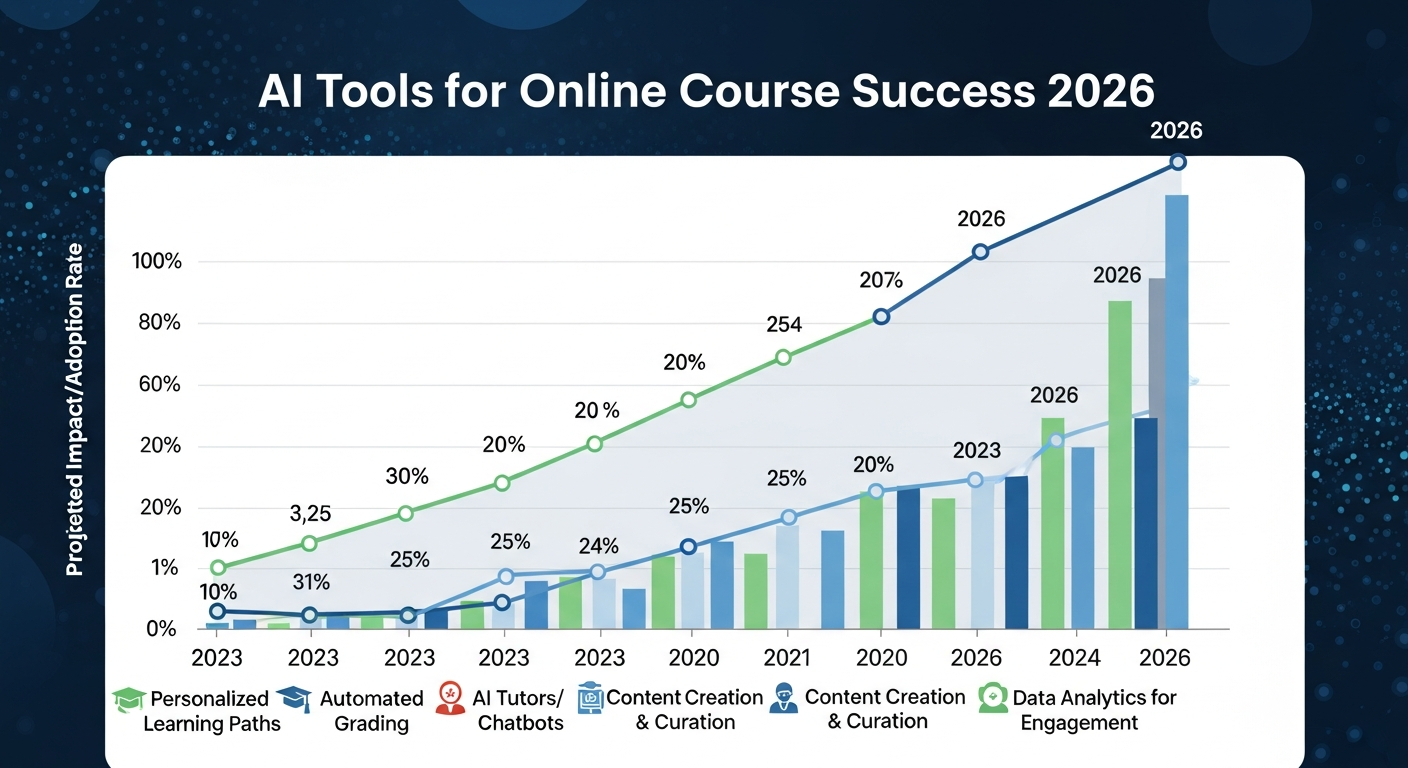
1. Fast content creation and enhancement
AI tools can write scripts, draft lesson notes, generate quiz questions, and produce summaries. They speed up what used to take hours. In my experience, a creator who uses AI can prototype a 4-week course in a fraction of the time.
- Use case: Installing a recorded lecture as a series of short micro, lessons and transcripts for SEO.
- Example: A 45 min video is given to AI transcript tool, top 8 teachable moments are extracted, and 1, 3 min clips are made for social promotion.
Quick tip: AI should not write the entire content for you. Use it just to draft and organize. Add your voice, anecdotes, and corrections. Students easily notice when content is generic. I always revise AI drafts to contain a real example or a little story from my own experience..
2. Personalization at scale
Personalization at scale One of the greatest strengths of AI learning commerce is personalization. It keeps an eye on and comprehends the behavior of the learner giving the personalized content, suggestions, and reminders. Hence, you can deliver a series of different learning paths to the learners who are new as well as to the learners, who have already mastered the advanced material.
Use case: Automatically suggest a follow, up course based on quiz results and time, on, module.
Example: A learner having difficulty with the basics is shown remedial modules. One who gets a high score is given advanced projects and a certificate fast track.
This type of dynamic routing results in increasing both retention and lifetime value. To put it simply, learners stay longer and buy more because the platform feels like it understands them.
3. AI-powered marketing and sales automation
AI is a great tool to; write copy, identify the best target for ads, experiment with the right pricing, andmanage chats for sales.These are issues in everyday commerce that can be improved by automation and data, driven testing.
Use case: Auto, generate email sequences and landing pages tailored for different buyer personas.
Example: Launch a fully automated A/B experiment where the AI changes the headlines, images, and CTAs, and then reallocates the budget to the best, performing combination.
It looks like small creators miss out on optimization because it seems technical to them. Only focus on one funnel element, such as subject lines, and let AI provide you with variations. You will get the result of what you are looking for without a large marketing team.
4. Smarter pricing and packaging
Pricing is definitely partly art and partly the science. AI brings the science in. It is a great help with dynamic pricing, bundling recommendations and identifying which promotions really result in measuring the bottom line.
Use case: Change the prices of a course depending on the region, season and user segment based on demand signals.
Example: AI finds out that a leadership course is in high demand in a certain industry and, therefore, proposes a small premium cohort at a higher price. On the other hand, be very careful. If you do dynamic pricing badly, it can result in learners being confused. Be transparent in your communication and try your changes on small segments first.
5. Enhanced learner support and retention
Chatbots and virtual teachers can handle common inquiries and provide minor assistance to students as they go through the learning material. They essentially free human coaches to be available for tasks with higher value. Those automated helpers have deepened their grasp of context and tone in their interactions. They can also deliver prompt feedback on the exercises and suggest what the learner should do next.
One Example: A chatbot responds to the technical questions concerning the features of the platform and guides the learners to the suitable modules.
One Story: A student wants to find out how to submit an assignment. The chatbot replies both with a step, by, step process and a shortcut. This lowers the student's anger and in fact, raises the student's commitment to completing the course.
6. Better analytics and insight
Better analytics and insight AI converts raw user interaction data into practical insights. Platforms no longer have to guess the reasons for people quitting, they can find weak modules, confusing quiz questions, or parts that lead to high churn just by looking at data.
- Use case: Predict which learners are likely to churn and initiate targeted interventions.
- Example: A predictive model identifies students who are most likely to drop out after skipping the second week . The platform then offers a one-on-one onboarding session or a condensed refresher.
Insights like this are one reason EdTech AI solutions are becoming central to operations. It’s cheaper to keep a learner than to acquire a new one.
Where AI fits inside your tech stack
Wondering where to add AI into your existing learning management systems? You do not need to rip everything out. AI can be added in layers.
Start with the point where you want the biggest commercial impact. Is it conversion on the sales page? Completion rates? Upsells? Then pick tools that integrate with your LMS or the CMS you use for marketing.
- Front end - AI copy and content modules for landing pages and course previews.
- Course layer - Content creation assistants, automated transcripts, and micro-lesson generators.
- Experience layer - Personalization engines and adaptive learning paths.
- Commerce layer - Dynamic pricing, promotions automation, and cart abandonment recovery.
- Operations layer - Analytics, churn prediction, and coach workflow optimization.
Companies like vidyanova are building tools that bring these layers together. They aim to combine content workflows with commerce features so creators and EdTech teams can move faster.

Practical AI tools and simple examples
Here are concrete tools and examples you can use right now. Keep the tasks bite sized. You’ll get faster wins that add up.
- Transcription plus clipping: Use an AI transcription service to break a long webinar into shareable clips for social ads. That drives traffic to your course landing page.
- Quiz generation: Feed your module outline to an AI and generate multiple choice and short answer questions. Then review and tweak them for accuracy.
- Email personalization: Use AI to rewrite welcome emails for different personas. Test which tones get the best open and click rates.
- Pricing experiments: You can test AI, assisted price suggestions on a partial audience segment. Check the conversion rates and the net present value of the customer before the general release.
- Chat, driven enrollment: Set a chat bot on your sales page and let it answer FAQs, schedule demos, and offer targeted deals to hesitant buyers.
- Content localization: Take advantage of AI translation and localization tools to modify the course materials for different markets without having to re, record everything.
These examples are small. They are meant to be doable. Start with one and measure the result.
Simple implementation plan - a 5 step checklist
If you want a low friction way to bring AI into your learning commerce work, follow this checklist. It is what I recommend to teams I advise.
- Pick one commercial goal. Choose something measurable like increasing free trial conversions or reducing churn by 10 percent.
- Identify where AI helps most. Map that goal to a capability, for example conversational sales for conversions or predictive analytics for churn.
- Choose a focused tool. Select a vendor or plugin that integrates with your LMS or CRM. Avoid the temptation to overhaul everything at once.
- Run a short pilot. Test with a small segment for 4 to 8 weeks. Collect the right metrics and user feedback.
- Iterate and expand. If the pilot shows lift, scale gradually and keep human oversight in the loop.
One common question I get is about budget. Do not overcommit. Start with a small pilot budget and measure lift. Most tools have trial tiers or usage-based pricing that fit this approach.
Common mistakes and pitfalls to avoid
AI is powerful, but it is not magic. Here are mistakes I see repeatedly.
- Over-automation. Automating everything eliminates human warmth. Your learners notice when interactions feel robotic. Keep humans in the loop for coaching and complex questions.
- Poor data hygiene. Garbage in, garbage out. If your engagement and sales data are messy, AI will suggest the wrong actions. Clean and standardize your data first.
- Ignoring bias. AI models reflect the data they were trained on. Watch for biased recommendations or content that excludes certain groups.
- Bad metric choices. Focusing only on acquisition numbers can hide problems. Pair commercial metrics with learning outcomes like mastery and completion.
- Privacy blind spots. Make sure your data handling complies with regulations like GDPR and with your own privacy policy. Be transparent with learners about how you use their data.
These are not theoretical. I’ve helped teams recover from each of these mistakes. The fix usually starts with one honest conversation about priorities and risk.
How AI changes the learner journey
Let’s walk through a simple learner funnel and highlight where AI adds value. This is practical and easy to visualize.
Awareness
AI helps by identifying content that resonates with target audiences, generating ad variations, and optimizing ad spend. It learns which creative works and who responds.
Consideration
Chatbots answer questions, course previews adapt to user interests, and personalized email sequences move people through the funnel. These small touches reduce friction and build trust.
Purchase
Use AI for pricing experiments, cart recovery, and one-click upsells. AI can also help create urgency that feels natural, like offering a cohort with limited seats because data shows those cohorts convert better.
Onboarding
First impressions matter. A tailored onboarding path suggested by AI helps learners hit momentum fast. Momentum equals retention.
Learning and mastery
Adaptive paths and automatic feedback mean learners receive instruction aligned with their pace. That improves outcomes and produces better testimonials and referrals.
Retention and advocacy
Predictive models surface at-risk learners and trigger timely interventions. When learners succeed, AI identifies the best upsell opportunities without being pushy. That creates advocates who refer other learners.
Measuring success - metrics that matter
To make AI work commercially, pick the right metrics. Here are the ones I track most often.
- Conversion rate by funnel stage. Track how AI changes the flow from awareness to purchase.
- Customer acquisition cost and payback period. Make sure your AI-driven spend produces profitable customers.
- Completion and mastery rates. These reflect learning quality, not just sales success.
- Churn and retention. Predictive models should reduce churn and increase lifetime value.
- Average revenue per user and upsell rate. AI should help you sell the right products to the right users at the right time.
- User satisfaction and NPS. Don’t lose sight of learner sentiment.
Measure both short-term lift and long-term value. AI can boost early conversions, but if learners don’t complete or succeed, that lift will fade.
Real-world examples you can copy
Here are three quick, actionable examples. Use them as templates.
Example 1 - Social clip funnel
Record a 60 minute live session. Use AI transcription and chaptering to generate six 60 second clips. Post clips as ads and organic posts. Link to a short landing page with a demo and an AI-powered chatbot. Result: more focused traffic and higher demo bookings.
Example 2 - Adaptive mini-course
Create a 3 module mini-course. Use an AI diagnostic quiz at the start to route learners into one of three paths. Offer a paid upgrade that fast-tracks the learner if they score above a threshold. Result: improved conversion on the upgrade and higher completion for the free path.
Example 3 - Pricing test matrix
Choose two course prices and two promotional bundles. Use AI to split traffic and monitor conversions and revenue per visitor. Let the system allocate more traffic to the best performing variant. Result: faster identification of an optimal price point and less manual A/B testing.
Each example is small, low risk, and testable in a few weeks. You can replicate them with common AI tools and plugins that integrate with popular LMS platforms.
Ethics, privacy, and governance
As you adopt AI-powered course platforms and solutions, think about governance. Who reviews AI outputs? How do you manage data access? What safeguards protect learner privacy?
My rule of thumb: if the AI is making decisions that affect price, access, or assessment, add a human review step. If you personalize content, allow learners to opt out. Give learners a way to see the recommendation rationale. Those steps build trust and reduce risk.
Also, document your data sources and retention policies. That protects you and helps learners feel confident in your platform.
What to expect next - short term trends
AI in learning commerce will keep getting more integrated. Expect better multimodal capabilities, where systems analyze text, audio, video, and learner interactions simultaneously. That will make personalization more precise and content creation more automated.
We will also see stronger plug and play integrations for LMS platforms. More platforms will offer AI-powered course workflows, from ideation to monetization. It will become easier to run personalized cohorts, dynamic pricing, and automated coaching.
And yes, regulations and scrutiny will increase. Companies that bake in privacy and human oversight now will have an advantage later.
Getting started - quick checklist
One final practical checklist to get you started right away:
- Define a single commercial goal for AI and one metric to measure it.
- Choose a focused use case like chat-driven sales, transcript-based content repurposing, or churn prediction.
- Select a low friction tool that integrates with your LMS or marketing stack.
- Run a short pilot and collect both quantitative and qualitative data.
- Review outputs regularly. Keep humans in the loop for quality control.
If you do those five things, you will learn quickly and avoid the most common pitfalls.
Conclusion
AI is not here to replace educators. It is here to remove drudgery, highlight what works, and let creative people focus on high value teaching and product strategy. When applied thoughtfully, artificial intelligence in commerce improves how courses are made, sold, and scaled.
Start small. Measure. Iterate. And keep the learner experience at the center. That’s how AI becomes a tool for better learning and better business at the same time.
Helpful Links & Next Steps
If you want to talk more about practical AI for your courses or platform, book a meeting and we can walk through a pilot plan together.
FAQs
1. What is learning commerce?
Learning commerce is the combination of online education and digital commerce, where courses, certifications, and learning programs are marketed, sold, and scaled using technology platforms.
2. How is artificial intelligence used in learning commerce?
Artificial intelligence is used to personalize learning paths, recommend courses, automate learner support, optimize marketing campaigns, and analyze learner behavior to improve course success.
3. How does AI improve online course engagement?
AI increases engagement by adapting content to learner skill levels, recommending relevant modules, sending smart reminders, and providing instant support through AI chatbots.
4. Can AI help increase online course sales?
Yes. AI helps improve conversions by identifying high-intent learners, personalizing landing pages, optimizing pricing, and automating follow-ups throughout the learner journey.