Exploring the Most Innovative Applications of AI in Education
AI in education is no longer just a buzzword. It is actually becoming the main tool for smarter classrooms, more effective online courses, and teaching methods that can be easily scaled. I’ve seen this change directly while collaborating with educators and course creators: small modifications with the help of artificial intelligence can make teachers have lots of free time, improve learner outcomes, and open up new revenue streams for teachers.
The intent behind this writing is to provide teachers, tutors, educational institutions, and learners with clear and easily implementable examples of how AI can revolutionize education. I will explain the most practical and innovative applications, what is effective, stumbling blocks, and your first steps. I will also integrate the way instructors can use platforms like VidyaNova to not only deliver AI, boosted courses but also to monetize them.
Why AI matters for teachers and learners
Honestly, teaching takes a lot of time. Making lessons, grading, giving feedback, and trying to keep students interested is all time that could be used for creative work. AI is good at taking over the boring repetitive tasks and at the same time it can offer personalized experiences which would be simply impossible to carry out on such a large scale without some kind of automation.
To me, the two greatest advantages of using AI in education are, first, personalization and, second, efficiency. Individualized learning paths make students more motivated. Automation liberates teachers to engage in high, impact activities such as mentoring, curriculum planning, and student outcome enhancement.

1. Personalized learning at scale
Adaptive learning systems incorporate various data from the students, such as performance, speed, and engagement, to decide on what content to be presented. These AI, powered systems keep on changing the level of difficulty, suggesting resources, and recommending practice exercises that fit the needs of each learner.
As an illustration, think of a math course where the system recognizes a student having trouble with fractions and as a result, it automatically issues targeted practice, video explanations, and a short formative quiz. Such a response mechanism helps the students to be on the right track.
- What to try: Place students at the correct level through the use of adaptive modules for core skills and diagnostics.
- Common pitfall: Depend completely on algorithmic recommendations without the intervention of a human. It is always wise to check the results of the adaptive tests and, accordingly, adjusting your teaching strategies.
2. AI tutors and on-demand help
AI tutors, powered by large language models and specialized AI agents, provide instant help to learners outside class hours. They can explain concepts, generate examples, and simulate Socratic questioning.
I’ve seen tutors use AI to handle common queries while they focus on conceptual mentoring. Students get immediate answers, and tutors step in for higher-order guidance.
Use cases include:
- Homework help bots that walk students through multi-step problems.
- Conversational agents that role-play interviews, debates, or language practice.
- Targeted revision helpers that pull together lecture notes, summaries, and practice questions.
3. Content creation and AI course creation
Creating course materials is the part most educators dread. Here's where AI course creation tools shine. They help generate outlines, draft lecture scripts, create quiz items, and summarize readings.
I've used AI to draft lesson plans and then customize them with my voice and examples. The time savings are real, what used to take days now takes a couple of focused hours.
Try these approaches:
- Generate a course skeleton with learning objectives and a suggested week-by-week plan.
- Use AI to produce multiple-choice items, then review for quality and bias.
- Once the video is ready, a quick pass to edit videos online with invideo Editor can trim it down, add captions, and give it a final polish.
Tip: Never publish AI-generated content without review. The machine can create strong drafts, but you’ll need to verify accuracy, contextual relevance, and tone.
4. Automated grading and assessment
Artificial intelligence systems are capable of evaluating multiple, choice tests, short answers, and even lengthy essays with a level of accuracy that is quite surprising. However, the machines do not substitute human judgment, they are only a few steps away, but they can detect problems, provide provisional scores, and thus, the teachers can have their grading time hours saved.
Automated grading is very effective when the assessment criteria are well, defined. It is less effective in dealing with creative or highly subjective work, unless a human intervention is involved.
- Employ AI to perform quick formative assessments and to provide immediate feedback.
- Use AI scoring along with human moderation for summative assessments.
5. Formative assessment and instant feedback
Providing timely feedback is the best way students learn. AI is that feedback, very fast, quite detailed, and in many cases, easily implementable. In case it is a language exercise or a coding problem, immediate hints can help learners find their way to a productive path again.
Being a teacher, you may also employ such AI, powered formative assessments to pilot your class activities, detect students' misunderstandings, and plan precise interventions.
6. Learning analytics and early-warning systems
Educational technology, powered predictive analytics can reveal students that may quit the school or be left behind. Such systems recognize patterns, presentations, homework, time of work, and report students who require help.
Essentially, this is how your control panel can notify you of a student, whom you have to check up on, prior to his/her disengagement. The result, changing type of teaching is exactly that.
However, it should be kept in mind that analytics are indicators, not diagnoses. It is still necessary for a person to use his/her judgment to understand the data and decide on the course of action.
7. Accessibility and inclusive learning
Artificial intelligence has introduced various means through which education can be made more inclusive and accessible to all students. Some of the examples are automated captioning, text, to, speech, and intelligent content adaptation, which can be very helpful learners with disabilities.
Once, I was collaborating with a tutor who employed AI, generated captions and audio summaries for a visually impaired student. In just a few weeks, the student's commitment and autonomy had risen so much that they were almost unrecognizable.
Some of the instruments that might be implemented are:
- It would be possible to have real, time captions and transcripts to accompany video lessons.
- One could also imagine text simplification tools that rewrite difficult passages at various reading levels.
- Moreover, adaptive interfaces, which are user, friendly and compatible with the needs of the learner and the assistive technologies, can be an option as well.
8. Immersive learning: AR, VR, and simulation
Artificial intelligence combined with Augmented reality (AR) and virtual reality (VR) can make education more engaging and interactive. They can be used to create virtual labs, a travel back in time to experience a historical event, or a simulated language immersion that helps learners practice their skills in a safe environment. These means of learning essentially break down difficult, to, understand concepts and allow learners to acquire skills without any risk.
I personally believe that immersion is most effective when it is supported by proper guidance and reflection. Students should not be left to figure out the VR world on their own, they should be provided with a framework, objectives, and a chance to discuss their experience.
9. Intelligent content recommendation
In the same way that streaming platforms recommend shows, AI can also suggest articles, videos, and practice exercises. This helps learners to stay engaged as they receive content that is both interesting and at the right level of their proficiency.
For educators, recommendation systems can be a great assistant in designing personalized learning journeys that achieve the dual goals of being efficient and engaging. However, a warning: monitor filter bubbles closely, a variety of content is equally important.
10. Teacher support and professional development
AI technology is not just for students only. Educators may also utilize artificial intelligence resources to create lesson plans, manage their classes, and foster their personal growth. Systems may review how you perform, recommend changes, and collect the most efficient methods from other teachers.
As I have said, educators that treat AI as their co, pilot and not as their rival have a higher efficacy in their work. Employ AI to generate concepts, and then take the professional decision.
11. Plagiarism detection and maintaining academic integrity
As online learning scales, academic integrity becomes an issue. AI tools can detect plagiarism, identify paraphrasing, and spot suspicious patterns in submissions.
However, this isn't foolproof. False positives happen. Context matters. Make integrity policies clear, teach citation skills, and use detection tools as part of a broader academic honesty strategy.
12. Conversational learning and language practice
Conversational agents are excellent for language learning and practice. Students can have endless low-stakes conversations to build fluency and confidence.
I've seen learners gain months of speaking practice in a compressed timeframe simply by interacting regularly with bots that provide correctives and vocabulary prompts.
13. AI for project-based and competency-based learning
Project-based learning benefits from AI by providing scaffolded feedback, milestones, and resource suggestions. In competency-based settings, AI helps track mastery and recommend the next steps.
This approach makes assessment continuous and aligned to skills rather than seat time, a big win for adult learners and professionals.
14. Monetization and course marketplaces
If you’re an educator looking to monetize your knowledge, AI can accelerate course creation and help you scale. Course marketplaces like VidyaNova are already integrating AI tools to help instructors create, market, and sell courses.
Here are the ways in which AI helps in making monetization more straightforward:- Faster content production: Producing draft lessons and quizzes to expedite course creation.
- Audience insights: Leverage analytics to know the buyers of your course and what content they interact with.
- Automated marketing: AI might be instrumental in copywriting, pricing strategy recommendation, and audience segmentation for email campaign facilitation.
15. Real-world examples and mini case studies
Examples serve to clarify this. Below are brief scenarios that depict AI working:
- Community College Math Lab: An adaptive platform was put in place to supplement the help given in, person by a tutor. Students, who regularly engaged with the system, improved their pass rates noticeably. Tutors stated that AI freed them from "drill" tasks which they could then concentrate on providing conceptual help.
- Language Tutor: A freelance tutor employed AI, generated lesson outlines and a speaking practice bot to triple one, on, one students without compromising quality.
- Corporate Upskilling Program: The use of automated micro, assessments and personalized learning paths was a company initiative. Completion rates went up because learners were given bite, sized content that was right for their role.
Common mistakes and pitfalls to avoid
Using AI in the classroom is effective, but one can easily make mistakes. Here are the mistakes that I have most often seen and the ways of avoiding them.
- Over, reliance on AI: Make use of AI as a tool with which to work rather than the teacher. AI is great for saving time, but a human still needs to take care of the details and the moral side.
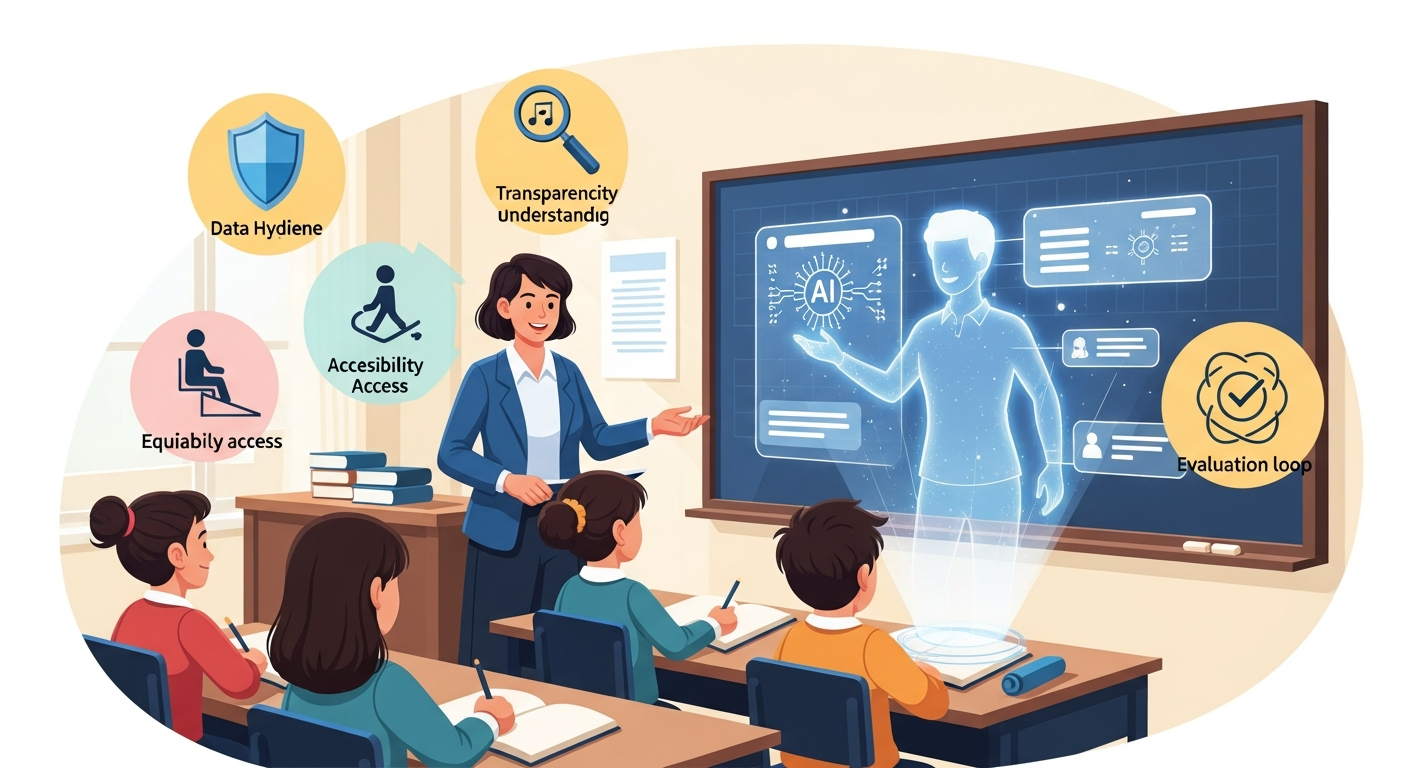
- Poor data hygiene: The quality of output depends on the quality of input. If student data is disorganized and biased, then AI suggestions will be incorrect. Make sure your data is clean and well, prepared.
- Lack of transparency: Students have the right to be informed if they are dealing with AI and how their data is being used.
- Not addressing accessibility: The AI tools might not be accessible to everyone. Use the assistive technology and involve different types of learners while testing.
- No evaluation loop: If you are not able to assess whether the usage of an AI tool leads to better results, then you are making a guess. Have defined success criteria.
Ethics, privacy, and responsible use
Artificial intelligence in education raises ethical and privacy questions. You’ll want to think about consent, data storage, bias mitigation, and model transparency.
Here are practical steps to stay responsible:
- Use opt-in consent for collecting student data.
- Prefer vendors that provide data protection agreements and clear deletion policies.
- Audit models periodically for bias, especially in grading or recommendation engines.
- Keep human-in-the-loop controls where high-stakes decisions are involved.
Teachers and institutions that prioritize ethics build trust and better long-term outcomes.
Practical implementation tips
Ready to start? Here’s a step-by-step framework I recommend when adopting AI in teaching:
- Start small: Pilot one use case, automated quizzes, formative feedback, or a content-generator for a single module.
- Set clear objectives: Define what success looks like: higher engagement, faster grading, better pass rates.
- Measure outcomes: Use baseline metrics and compare after implementation. Track both learning analytics and student satisfaction.
- Train staff: Invest in short workshops so teachers understand tool capabilities and limitations.
- Iterate: Collect feedback, refine prompts, and adjust the human-AI workflow.
How to choose AI tools for teachers
With so many products out there, choosing an AI teaching tool can be overwhelming. I look for a few key qualities:
- Ease of integration: Can it plug into your LMS or content platform?
- Transparency: Does the vendor explain how models make decisions?
- Customization: Can you tailor outputs to your curriculum and voice?
- Data protection: Is student data secure and deletable?
- Human-in-the-loop features: Does it let teachers review and override suggestions?
Choosing the right tool is often less about flashy features and more about how the product fits your workflows and values.
AI teaching tools and platforms worth exploring
Below are categories to explore, each includes brief examples of how they're used in practice. (I won’t name every vendor; instead, focus on what to expect from the category.)
- Adaptive learning platforms: Personalized pathways and targeted practice based on performance.
- Generative content tools: Draft lessons, summaries, and assessment items.
- Conversation agents: Language practice, tutoring, and Q&A bots for out-of-class support.
- Automated grading systems: Bulk grading for objective and semi-subjective tasks with human review options.
- Analytics dashboards: Early-warning indicators and cohort analysis to guide interventions.
Monetizing courses with AI: a quick playbook
If you're an educator or trainer looking to earn from your expertise, AI helps you get courses market-ready faster. Here’s a short playbook I recommend:
- Outline quickly: Use AI to produce a draft syllabus and module plan.
- Build content in batches: Generate lecture scripts, quizzes, and resource lists. Then personalize them with your voice.
- Pilot with a cohort: Run a small paid pilot, gather feedback, and iterate.
- Optimize listings: Use AI-assisted copywriting to craft course descriptions and marketing materials. Focus on benefits and outcomes.
- Leverage a marketplace: Publish on a platform like VidyaNova to tap into an existing audience and built-in tools for course management and sales.
One thing I’ve learned: students buy outcomes, not features. Make sure your course copy emphasizes practical skills, measurable results, and time-to-value.
What the future holds
We're still early in the AI in education journey. Models will get better at understanding context, evaluating complex work, and supporting socio-emotional learning. Expect more collaboration between humans and AI where tools suggest interventions and teachers apply the nuance.
In the next few years, I anticipate:
- Richer multimodal tutors that combine text, speech, images, and video feedback.
- Better fairness and bias mitigation baked into educational models.
- Integration of immersive AR/VR with AI-driven adaptive feedback.
- More teacher-focused AI tools that prioritize efficiency and professional growth.
Final thoughts: balance and intention
AI in online learning and classroom settings offers enormous promise. Still, success depends on intentional use. In my experience, the best outcomes come from blending AI’s efficiency with human empathy and pedagogical expertise.
Start with a clear problem to solve, run small pilots, involve stakeholders, and prioritize ethics and transparency. That approach keeps the technology serving learners, not the other way around.
Helpful Links & Next Steps
- VidyaNova - AI-powered course marketplace and platform for educators
- VidyaNova Blog - Articles and guides on educational technology and course creation
Start Teaching Smarter with AI, Join VidyaNova Today!
Quick checklist to get started this week
- Pick one small task (grading, quiz generation, or summaries) to automate.
- Run a two-week pilot with clear metrics: time saved, student satisfaction, or improved scores.
- Train your teaching team on the chosen tool and document workflows.
- Make students aware of AI use and get consent where necessary.
- Iterate based on data and feedback, don’t expect perfection on day one.
If you’re curious about practical tools, course marketplaces, or ideas for monetizing your teaching content, I’m confident VidyaNova can help you move from concept to launch faster. Good luck; teach smarter, not harder.