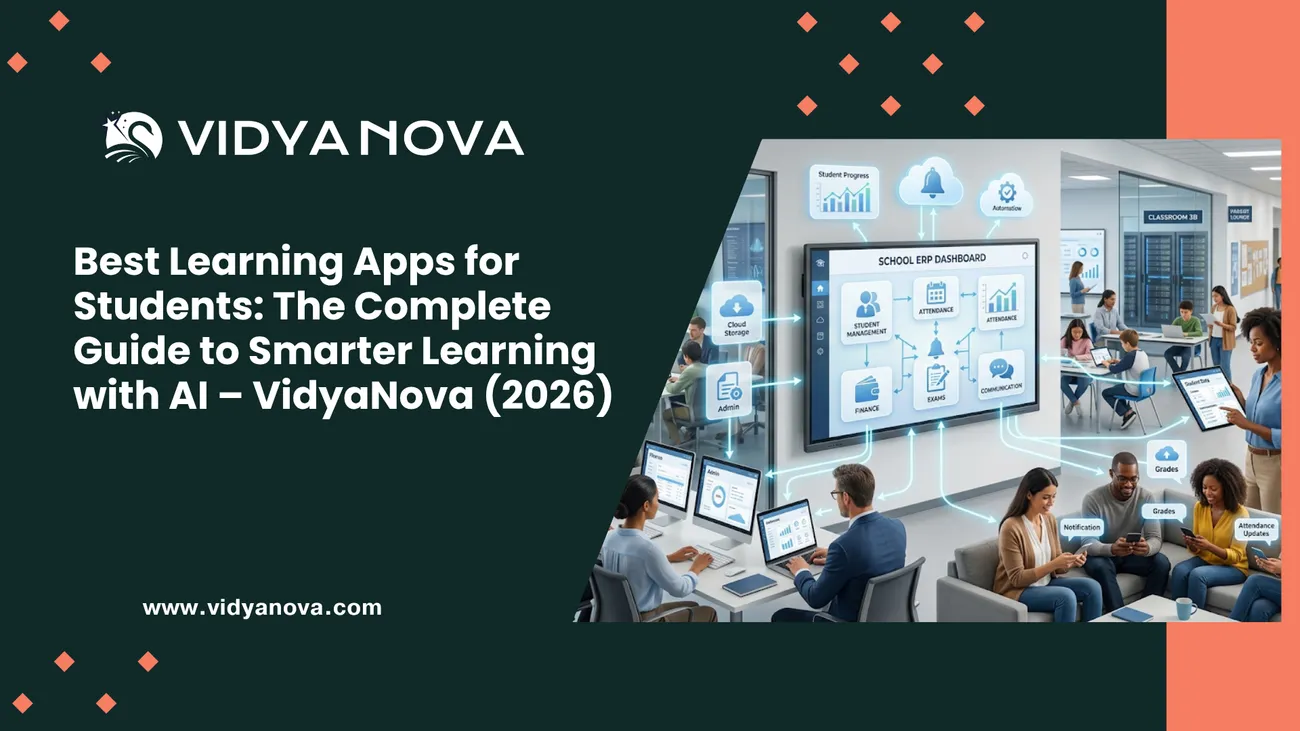
Best Learning Apps for Students: The Complete Guide to Smarter Learning with AI – VidyaNova (2026)
Best Learning Apps for Students: The Complete Guide to Smarter Learning with AI – VidyaNova (2026) explores how learning apps are transforming education by making studying more flexible, interactive, personalised, and accessible.
The blog explains what learning apps are, why students use them, and the key features to look for, including AI-powered personalisation, interactive quizzes, progress tracking, instant feedback, self-paced learning, and learning analytics.
It also highlights how AI is changing education by helping students identify learning gaps, receive personalised recommendations, practice through AI-generated assessments, and learn at their own pace. The article emphasises that AI should support teachers and students rather than replace human teaching and critical thinking.
What Are Learning Apps for Students?
Learning apps are digital applications designed to help students learn, practice, revise, and develop academic or professional skills.
They can be accessed through smartphones, tablets, computers, or other connected devices.
Learning apps may focus on a specific subject or provide broader educational experiences.
Examples include apps for:
Mathematics
Science
Languages
Coding
Business
Artificial Intelligence
Data Analytics
Exam preparation
Professional development
Communication skills
General knowledge
Modern learning apps can combine videos, reading materials, quizzes, assignments, interactive activities, progress tracking, and AI-powered recommendations.
Instead of depending entirely on traditional classroom instruction, students can use these platforms to continue learning outside the classroom.
Why Are Learning Apps Important for Students?
Traditional education generally follows a fixed schedule and curriculum.
Every student may receive the same lesson, at the same time, regardless of their individual learning speed.
Learning apps provide greater flexibility.
Students can:
Learn whenever they want
Study at their own pace
Repeat difficult lessons
Practice through quizzes
Track their progress
Access learning resources from anywhere
Learn using mobile devices
Receive instant feedback
Explore additional topics
Build consistent study habits
This flexibility is particularly useful for students balancing school, college, competitive examinations, internships, jobs, and other responsibilities.
Best Learning Apps for Students: What Should You Look For?
Not every educational app provides the same learning experience.
Before choosing a learning app, students should evaluate several important features.
1. Personalised Learning
The best learning apps should adapt to the learner rather than forcing every student through exactly the same experience.
Personalization can include:
Recommended topics
Personalized revision
Difficulty adjustment
Progress-based recommendations
Individual learning paths
Targeted practice
AI can make personalization more effective by analyzing student activity and performance.
2. Interactive Learning
Reading long chapters continuously can make studying difficult.
Interactive features can make learning more engaging through:
Quizzes
Flashcards
Practice questions
Interactive exercises
Simulations
Discussions
Assignments
Instant feedback
Interactive learning encourages students to actively participate instead of simply consuming information.
3. Progress Tracking
Students need to know whether their learning is actually improving.
A good learning app should provide insights such as:
Course completion
Topic completion
Quiz performance
Assignment progress
Learning activity
Strengths
Areas for improvement
Progress tracking also helps students stay accountable.
4. AI-Powered Learning
Artificial Intelligence is becoming one of the most important features of modern education technology.
AI can help students by:
Generating practice questions
Recommending learning materials
Explaining concepts
Creating personalized learning paths
Identifying learning gaps
Providing automated feedback
Supporting revision
However, students should not treat AI as a replacement for teachers or critical thinking.
The best use of AI is as a learning assistant that supports understanding and practice.
5. Flexible Learning
Students have different schedules and learning preferences.
A useful learning platform should support:
Self-paced learning
Live classes
Recorded lessons
Mobile access
Flexible course structures
Topic-based learning
Flexibility makes it easier for students to fit learning into their daily routines.
10 Benefits of Learning Apps for Students
1. Learn at Your Own Pace
One of the biggest advantages of learning apps is flexibility.
Students can pause, repeat, revise, and continue lessons according to their individual learning speed.
A student who understands a topic quickly can move ahead, while someone struggling with a concept can spend more time practicing it.
2. Improve Knowledge Retention
Interactive learning can improve how students engage with educational material.
Instead of simply reading information, students can reinforce knowledge through:
Quizzes
Repetition
Practice
Flashcards
Assignments
Revision exercises
Repeated interaction with a topic can help strengthen understanding and recall.
3. Increase Student Engagement
Digital learning platforms can make lessons more interactive.
Features such as quizzes, progress indicators, assignments, and personalized recommendations can encourage students to participate more actively.
Engagement is particularly important when students are learning independently.
4. Personalized Learning Experience
Every student has different strengths, weaknesses, interests, and learning speeds.
AI-powered platforms can use learner data to recommend relevant content and activities.
For example, if a student consistently performs poorly in a particular topic, the platform can recommend additional practice or revision material.
5. Instant Feedback
Traditional assignments may require students to wait before receiving feedback.
Digital learning apps can provide immediate feedback for many types of assessments.
This allows students to:
Attempt a question
Receive feedback
Understand the mistake
Review the concept
Try again
This creates a faster learning cycle.
6. Convenient Access to Learning
Learning apps allow students to access educational resources from almost anywhere.
Instead of carrying multiple books or depending entirely on classroom schedules, students can access digital content using connected devices.
This makes learning more convenient for students with different schedules and learning environments.
7. Better Study Organization
Students often struggle to organize their learning materials.
Learning platforms can bring courses, lessons, assignments, quizzes, and progress information into one place.
This can reduce the time students spend searching for resources.
8. More Practice Opportunities
Practice is essential for mastering many subjects.
Learning apps can provide additional exercises without requiring students to wait for the next classroom session.
Students can practice:
Mathematics problems
Coding exercises
Language vocabulary
Science concepts
Business concepts
Exam questions
9. Develop Independent Learning Skills
Learning apps can encourage students to take greater responsibility for their education.
Students can decide:
What to study
When to study
Which topics require revision
How much time to spend practicing
These habits can become valuable beyond academic education.
10. Support Lifelong Learning
Learning doesn't stop after school or university.
Students can continue developing skills in areas such as:
Programming
Artificial Intelligence
Data Analytics
Digital Marketing
Communication
Entrepreneurship
Business
Professional skills
Learning apps make continuous education more accessible.
How AI Is Changing Learning Apps for Students
Artificial Intelligence is transforming educational technology from simple content-delivery systems into intelligent learning environments.
Traditional learning applications mainly provide educational materials.
AI-powered platforms can analyze how students interact with those materials and provide more personalized experiences.
AI can support education through:
Personalized Recommendations
AI can recommend topics and learning resources based on student performance and activity.
AI-Generated Assessments
AI can help educators create quizzes, practice questions, and assessments more quickly.
Automated Feedback
Students can receive feedback on certain activities without waiting for manual evaluation.
Learning Analytics
Educators can analyze learner performance and identify areas that require additional attention.
Intelligent Content Creation
AI can help educators create course structures, learning modules, questions, and other educational resources.
Adaptive Learning
AI-powered systems can adjust learning experiences according to individual student needs.
Learning Apps vs Traditional Learning
Learning apps should not necessarily be viewed as a replacement for traditional education.
Instead, they can complement classroom learning.
Traditional LearningLearning AppsFixed classroom scheduleFlexible learningSame pace for many studentsSelf-paced learningPhysical learning materialsDigital resourcesDelayed feedback in some casesInstant feedback for many activitiesLimited practice outside classAdditional practice opportunitiesManual progress trackingDigital analyticsTeacher-led instructionTeacher + technology-supported learning
The strongest model is often a combination of effective teaching and technology.
Teachers provide experience, context, mentorship, and human interaction.
Technology can provide scalability, automation, personalization, and analytics.
How Students Can Use Learning Apps Effectively
Simply downloading an educational app does not guarantee better academic performance.
Students need a structured approach.
1. Set Specific Learning Goals
Instead of saying:
"I want to study Python."
Create a specific goal:
"I want to complete Python fundamentals and build two beginner projects this month."
Specific goals make progress easier to measure.
2. Create a Consistent Study Schedule
Consistency is more important than studying for long hours occasionally.
For example:
30 minutes of learning
15 minutes of practice
10 minutes of revision
A structured routine can help build sustainable learning habits.
3. Practice Instead of Only Watching
Watching educational videos can feel productive without necessarily creating deep understanding.
Students should combine content consumption with:
Questions
Exercises
Quizzes
Projects
Assignments
Revision
4. Review Difficult Topics
When an assessment reveals a weak area, students should revisit that topic rather than simply moving forward.
Learning apps can make this process easier by organizing topic-wise learning and progress.
5. Use AI as a Learning Assistant
AI can explain concepts, generate practice questions, and provide learning support.
But students should verify important information and make sure they understand concepts themselves.
The goal should be learning with AI, not outsourcing learning to AI.
Best Features of a Modern Student Learning Platform
When evaluating an educational platform, students, educators, and institutions should look for features such as:
✅ AI-powered course creation
✅ Personalized learning
✅ Topic-wise learning modules
✅ AI-generated quizzes
✅ Assessments
✅ Assignment management
✅ Live learning
✅ Self-paced learning
✅ Real-time analytics
✅ Progress tracking
✅ Learner management
✅ Batch management
✅ Interactive learning
✅ Flexible learning options
These features can turn a basic content platform into a complete digital learning environment.
How Educators Can Use Learning Apps
Learning apps are not only useful for students.
Educators can use them to simplify many parts of the teaching process.
Teachers can:
Create digital courses
Organize learning modules
Generate quizzes
Assign coursework
Monitor learner progress
Analyze student performance
Identify learning gaps
Deliver live sessions
Provide self-paced content
Manage batches
This allows educators to spend less time managing repetitive administrative tasks and more time supporting students.
How Institutions Can Benefit from Learning Platforms
Schools, colleges, universities, and coaching institutes can use learning platforms to scale digital education.
Institutions can:
Centralize learning resources
Manage multiple courses
Track student performance
Manage batches
Monitor engagement
Support online and blended learning
Analyze learning outcomes
Build branded learning environments
For institutions managing large numbers of learners, analytics can provide valuable insights into how students are progressing.
Learn Smarter with VidyaNova
VidyaNova is an AI-powered Learning Management System designed to help educators, institutions, and learners create and manage modern learning experiences.
Instead of simply providing educational content, VidyaNova combines AI-powered tools, interactive learning, assessments, analytics, and flexible learning options.
Whether you're a student learning a new skill, an educator creating courses, or an institution managing large learner groups, VidyaNova can support different stages of the learning journey.
Key VidyaNova Features
✅ AI-powered course creation
✅ Topic-wise learning modules
✅ Flexible pay-per-topic learning
✅ AI-generated quizzes and assessments
✅ Live and self-paced learning
✅ Real-time learner analytics
✅ Progress tracking
✅ Assignment management
✅ Batch management
✅ Interactive learning experiences
✅ Custom branding for institutions
With these tools, educators can create structured learning experiences while students can access content, complete assessments, and track their learning progress.
Why Choose VidyaNova for Student Learning?
VidyaNova focuses on making learning more flexible, interactive, and data-driven.
AI-Powered Learning
AI can help educators create learning content and assessments more efficiently while supporting personalized learning experiences.
Flexible Learning
Students can learn through live and self-paced formats depending on their learning needs.
Topic-Based Learning
Students can focus on specific topics rather than necessarily committing to an entire course.
Progress Tracking
Learners and educators can monitor progress and performance through analytics.
Interactive Assessments
Quizzes and assessments help reinforce concepts and provide opportunities for practice.
Scalable Education
VidyaNova can support individual learners as well as institutions managing multiple courses and learner groups.
Are Learning Apps Better Than Traditional Education?
Learning apps are not automatically better than traditional education.
That would be an oversimplification.
Their value depends on how they are designed and used.
A poorly designed app can create distractions, encourage passive learning, or overwhelm students with excessive content.
A well-designed learning platform can complement teachers by providing:
Additional practice
Personalized learning
Flexible access
Instant feedback
Progress tracking
Learning analytics
The most effective approach is to combine technology with good teaching practices.
Frequently Asked Questions (FAQs)
1. What are the best learning apps for students?
The best learning apps depend on the student's goals, subject, age, learning style, and academic requirements. A good learning app should offer useful educational content, interactive learning, assessments, progress tracking, and ideally personalized learning features.
2. Are learning apps useful for school and college students?
Yes. Learning apps can support students with revision, practice, assignments, skill development, exam preparation, and additional learning outside the classroom.
Their effectiveness depends on the quality of the content and how consistently students use them.
3. How do AI learning apps help students?
AI learning apps can personalize learning recommendations, generate practice questions, provide explanations, analyze performance, identify learning gaps, and support interactive learning experiences.
AI should be used as a learning assistant rather than a replacement for teachers or independent thinking.
4. Can learning apps improve student engagement?
Learning apps can improve engagement when they use interactive activities, relevant content, assessments, progress tracking, and personalized learning experiences.
However, simply adding technology does not guarantee engagement. The quality of the learning experience matters.
5. Are learning apps suitable for self-paced learning?
Yes. Self-paced learning is one of the major benefits of digital learning platforms.
Students can often decide when to study, revisit difficult topics, and progress according to their individual learning speed.
6. What features should students look for in a learning app?
Students should consider features such as:
Quality educational content
Interactive lessons
Quizzes and assessments
Progress tracking
Personalized recommendations
AI-powered learning support
Self-paced learning
Live learning options
Assignment management
Accessible user experience
7. How can teachers benefit from learning apps?
Teachers can use learning apps to create courses, organize learning materials, generate assessments, assign work, monitor student progress, analyze performance, and deliver live or self-paced learning.
This can reduce repetitive administrative work and give educators better visibility into learner performance.
8. How can VidyaNova help students and educators?
VidyaNova provides an AI-powered learning environment with tools for course creation, topic-based learning, quizzes, assessments, live and self-paced learning, progress tracking, analytics, assignments, and learner management.
It is designed to support students, educators, and institutions in creating more flexible and engaging learning experiences.
Explore VidyaNova:
9. Is AI going to replace teachers?
AI is unlikely to replace the full role of teachers because education involves mentorship, communication, emotional support, context, judgment, and human interaction.
Instead, AI can automate repetitive tasks and provide additional insights that help educators teach more effectively.
10. Are learning apps useful for lifelong learning?
Yes. Learning apps can make it easier for people to continuously develop academic, technical, professional, and personal skills.
Students can continue learning beyond traditional classrooms and build skills throughout their careers.
Conclusion
The best learning apps for students are no longer simply digital versions of textbooks.
Modern learning platforms are becoming intelligent educational environments that combine content, interaction, assessments, analytics, personalization, and AI-powered support.
For students, this can mean greater flexibility, more opportunities to practice, personalized learning experiences, and better visibility into their progress.
For educators, learning apps can simplify course creation, assessments, learner management, and performance tracking.
For schools, colleges, universities, and coaching institutes, digital learning platforms can provide scalable infrastructure for modern education.
However, technology alone does not create better learning. The most effective results come when high-quality educational content, good teaching practices, consistent student effort, and intelligent technology work together.
With AI-powered platforms like VidyaNova, educators and institutions can build more engaging learning experiences while students gain access to flexible tools designed for modern learning.
Whether you're a student developing new skills, an educator creating digital courses, or an institution looking to modernize learning, the right learning platform can make education more accessible, interactive, and personalized.
Ready to Make Learning Smarter?
Start your journey with VidyaNova, the AI-powered learning platform built for modern education.
With VidyaNova, you can:
✅ Learn at your own pace with flexible pay-per-topic courses
✅ Create AI-powered courses in minutes
✅ Generate quizzes and assessments automatically
✅ Track learner progress with real-time analytics
✅ Deliver live and self-paced learning
✅ Manage learners, assignments, and batches effortlessly
🌐 Explore VidyaNova: https://vidyanova.com/
📅 Book a Free Demo: https://meet.kalnexa.com/agami/vidyanova?month=2026-03
Related Resource
Microlearning Guide:
https://vidyanova.com/blog/what-is-microlearning-benefits-examples-why-its-shaping-the-future-of-learning-2026
Watch Vidyanova Youtube: https://youtube.com/@vidyanova?si=k07Wv6A-te7pj1Av