Topic-Based Learning & Pay-Per-Topic Models: Engagement and Monetization
Discover how breaking courses into topic blocks and pricing by topic can boost engagement, personalize learning, and create new revenue streams. This practical guide walks you through designing topic paths, building microlearning modules, and monetizing with a pay-per-topic model using VidyaNova tools.
What is Topic-Based Learning and Pay-Per-Topic Pricing?
Topic-Based Learning is a modular approach where knowledge is organized into focused topics rather than whole courses. Each topic is a digestible unit that learners can complete on their own timeline, often accompanied by short assessments and embedded practice. Pay-Per-Topic pricing pairs this structure with a per-topic charge, enabling learners to pay only for the topics they choose. For educators and institutions, this creates a flexible catalog that scales with learner needs and market demand.
In VidyaNova, topic-based modules are empowered by AI-assisted content generation, quizzes, and adaptive learning recommendations that help you craft high-value topics quickly while maintaining quality. This pairing makes it practical to run topic libraries at scale without the overhead of fully packaged courses.
Designing Topic Paths and Microlearning Modules: a practical framework
Designing effective topic paths demands a clear throughline from fundamentals to mastery. Use a lightweight, repeatable framework to turn complex subjects into connected topic trees. Here’s a practical 6-step approach you can apply right away:
- Map core competencies: Identify the central skills learners must demonstrate. For example, in digital marketing, core competencies might include SEO basics, content strategy, and analytics interpretation.
- Decompose into topics: Break each competency into 2–5 focused topics. Each topic should be solvable in 15–25 minutes of focused work.
- Define prerequisites: Decide the order and dependencies so learners don’t hit walls. A topic on 'Keyword Research' should come after a primer on 'Digital Marketing Foundations.'
- Create microlearning assets: Use short videos, textual briefs, quick exercises, and one-page templates. Aim for high-density value in a tight package.
- Embed lightweight assessments: Quick quizzes or performance tasks at the end of each topic validate learning and feed the AI-driven recommendations for the next topics.
- Sequence and price: Plan a learning path that flows logically and price topics based on depth, demand, and strategic value. A set of starter topics might be priced lower to attract initial learners; advanced topics can command higher per-topic pricing.
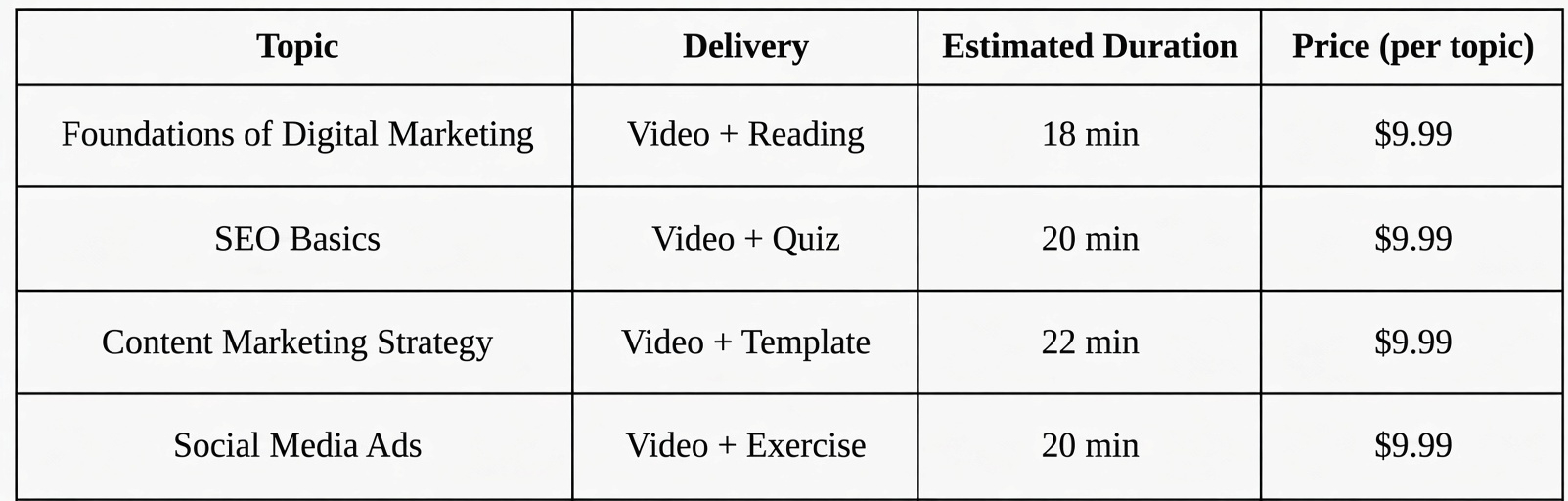
Real-world example: a mid-size institute launches a “Digital Marketing Essentials” micro-library with topics like Foundations, SEO Basics, Content Marketing, Social Ads, Email Campaigns, and Analytics. Each topic runs 15–20 minutes and includes a 5-question quiz. A learner can start with Foundations and then pick any other topics to build a personalized path. See the table below for a sample topic mix and delivery style.
Pro tip: structure topics around learner goals. For vocational tracks, offer a “core path” of 4–6 topics that graduates can bundle with a more advanced topic set. Use VidyaNova’s AI Course Creation to generate initial topic briefs and AI Content Generator to populate draft material, then review and adapt to your brand voice.
Monetization and Pay-Per-Topic Pricing: strategies that fit real learners
Per-topic pricing gives learners the freedom to assemble a learning journey that matches their budgets and goals. It also creates a clear upsell path as topics accumulate into a library of value. Here are practical pricing approaches that have worked in practice:
- Single-topic pricing: Charge a fixed price per topic (for example, $9.99). Simple, transparent, and easy to forecast revenue.
- Topic bundles: Offer bundles of 3–5 topics at a discounted rate (e.g., 3 topics for $24.99). Bundles encourage deeper exploration and higher ARPU.
- Library access or subscription: Provide access to a curated topic library for a monthly fee, enabling ongoing discovery and retention.
- Tiered topic sets: Create tiers such as “Foundations,” “Advanced,” and “Specialized” with increasing depth and price. This blends affordability with prestige.
Worked example: A coaching institute starts with 6 topics priced individually at $9.99 each. If 40% of learners buy all 6 topics as a library bundle for $39.99, and 30% purchase three-topic bundles at $24.99, you can model revenue as follows: 150 learners in a month × 6 topics × $9.99 = $8,955 if every topic is purchased individually. If 60 buyers opt for bundles (split 30 two bundles and 30 three-topic bundles), monthly revenue would be approximately $2,992 from bundles + $5,955 from per-topic sales, totaling around $8,947 — a modest uplift driven by bundling and choice. The real optimization is testing different price points and bundling to find the sweet spot for your audience.
ROI and Key Metrics: what to watch when you go topic-based
Moving to topic-based learning shifts the metrics you track. The right data tells you whether a topic is resonating, how quickly learners progress, and whether your pricing invites continued exploration. Focus on a core set of indicators:
- Engagement rate: share of learners who start a topic and complete it.
- Topic completion rate: proportion of learners who finish the topic’s quiz or assessment.
- Average revenue per user (ARPU) per month and per topic path.
- Lifetime value (LTV) of a learner who completes multiple topics versus a single topic.
- Churn and re-engagement: how many learners drop off after a topic and whether targeted micro-learning nudges bring them back.
Example: A small university department launches a topic library around “Data Literacy for Researchers.” With per-topic pricing of $12.99 and a 6-topic path, the first month yields 200 new learners. If 42% complete all six topics, 80% of completers progress to at least one more topic, and the library-level ARPU grows to $23 per learner, you’re looking at a 15–20% uplift in revenue from the prior all-course model. The trick is to balance value, pacing, and pricing so that learners feel rewarded for deeper engagement.
Implementation playbook: using VidyaNova to enable topic-based modules
Turning theory into practice requires aligned tooling. VidyaNova brings together AI-assisted content creation, AI-generated quizzes, and a flexible pay-per-topic framework. Here’s a concise, actionable playbook you can follow to launch or upgrade your topic-based offering:
- Start small: Pick 3–4 high-demand topics as a pilot to validate demand and pricing.
- Outline topics with AI: Use AI Course Creation to generate topic briefs covering outcomes, core concepts, and assessment ideas; tailor the tone to your audience.
- Generate content and assessments: Deploy AI Content Generator for draft text, visuals, and activities; run AI Quiz Generator for quick, scorable quizzes aligned to each topic.
- Set up pricing and paths: Create per-topic pricing, bundles, and milestones in VidyaNova. Design recommended paths to guide learners and improve progression.
- Track and iterate: Use Real-Time Analytics to monitor engagement and adjust topics, length, or pricing weekly if needed.
- Scale with confidence: Once the pilot succeeds, expand the catalog, add branded topics, and deploy across cohorts with batch management and learner analytics.
In practice, marketers and educators who combine AI-assisted content with Pay-Per-Topic pricing can cut development cycles by 40–60% while maintaining quality. VidyaNova’s platform makes this transition smoother by centralizing topic management, payments, and analytics in one place.
Common mistakes and how to avoid them
- Underestimating topic scope: Treat topics as scalable units with clear learning outcomes; otherwise, learners feel misled by short content that lacks depth.
- Overpricing early: Start with value-based pricing and test price sensitivity using micro-bundles before raising prices.
- Poor topic sequencing: Ensure your path builds logically and avoids redundant topics; prerequisites should prevent confusion, not limit curiosity.
- Neglecting quality control: AI helps draft content, but human review remains essential for accuracy and brand voice.
- Ignoring analytics: If you don’t track engagement and completion, you won’t know which topics to prune or expand.
Real-world example: a coaching institute going topic-based
Consider a three-branch coaching institute offering exam-prep content. They launch a topic library around “Comprehensive Exam Readiness” with 6 topics spanning core concepts, practice tests, and strategy. Each topic is priced at $9.99. They run a 6-topic bundle for $49.99 and a three-topic starter bundle for $24.99. In month one, they enroll 450 learners, with 38% purchasing at least one topic and 12% buying the 6-topic bundle. Revenue from per-topic sales equals roughly $17,190; bundle sales add about $5,999. Within two quarters, learners who complete two or more topics show higher course completion rates and return for more topics, driving a measurable lift in retention and long-term revenue.
When to adopt Topic-Based Learning
If you want more learner choice, faster time-to-value, and the ability to monetize tastefully across a catalog, Topic-Based Learning is worth pursuing. Look for these readiness indicators: a catalog-ready set of topics, clarity on outcomes, buy-in from instructors or program leads, and a platform capable of handling pay-per-topic payments and microlearning formats. If your audience values flexibility and personalization, you’re likely ready to design and test a topic-path approach with VidyaNova’s tooling.
Conclusion: practical, profitable, and learner-friendly
Topic-Based Learning paired with Pay-Per-Topic pricing offers a practical path to create personalized, programmatic learning experiences without locking learners into whole courses. By mapping topic paths, delivering concise micro-learning modules, and pricing thoughtfully, educators and institutions can boost engagement, improve completion, and unlock new revenue streams. Use AI-assisted content creation to accelerate development, but keep human oversight to preserve quality and brand voice.
Frequently Asked Questions
What is the core advantage of Topic-Based Learning?
The primary benefit is learner choice. Students can select topics that align with their goals and budget, leading to higher engagement and faster time-to-value. It also enables educators to monetize content piece by piece rather than relying on full-course sales.
How should I price topics?
Start with transparent per-topic pricing and add bundles that offer meaningful savings for learners who want multiple topics. Test different price points and bundle sizes with a pilot group to identify the sweet spot for your audience.
How does AI fit into this model?
AI can accelerate content generation, quiz creation, and topic briefs, reducing development time and enabling rapid catalog growth. Use human review to ensure accuracy and alignment with your brand voice and learning objectives.
Is Topic-Based Learning suitable for institutions?
Yes. Institutions can brand topic libraries, manage cohorts, and monetize content at scale. The pay-per-topic model pairs well with live or self-paced formats and supports flexible licensing for institutions.
Helpful Links
Explore related resources and next steps to deepen your topic-based learning strategy.
Ready to design your topic-based learning and Pay-Per-Topic pricing?
Let’s tailor a plan for your institution or coaching business. Book a personalized walkthrough with VidyaNova to map topic paths, create microlearning modules, and configure pricing.